
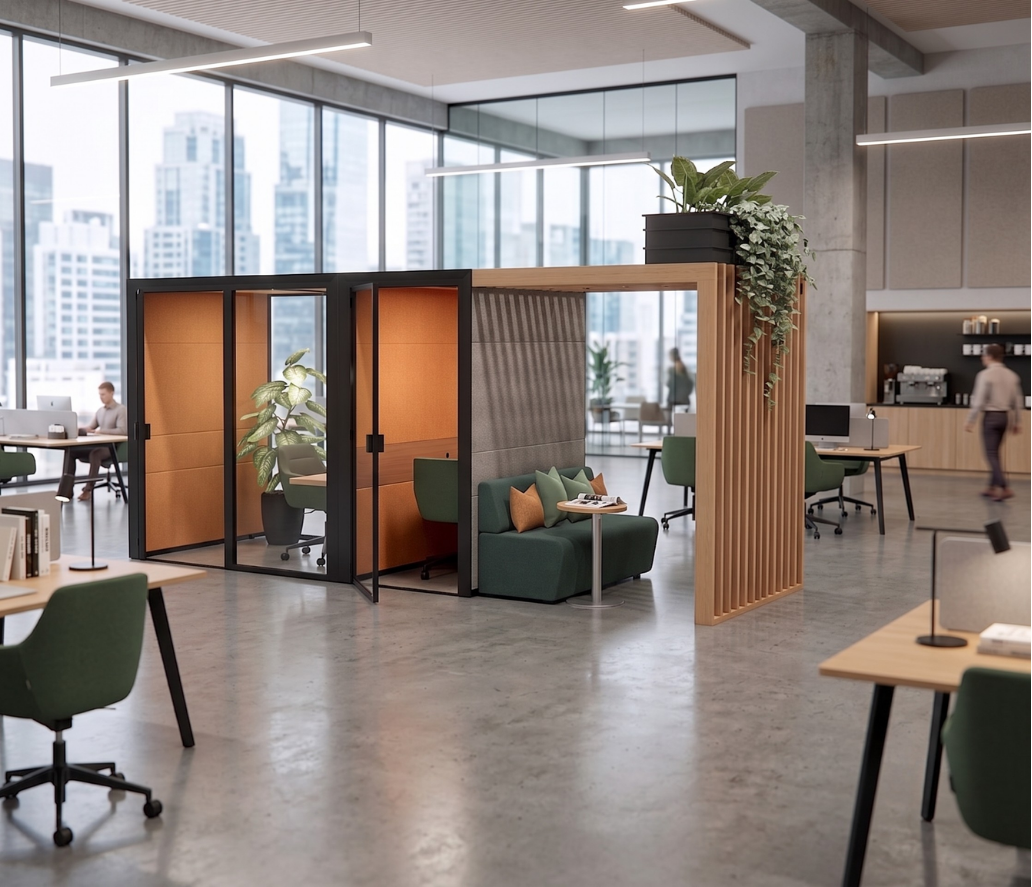
Office Pod Buyer’s Guide: What to Know Before You Choose
Open-plan offices were built for collaboration, but they broke concentration. Workers lose roughly 20 minutes of focused time every time a nearby conversation or phone call pulls them out of deep work, and there is no wall to retreat behind. The office pod exists because rearranging furniture never solved that problem.
In this post, we'll take a look at:
What Is an Office Pod?
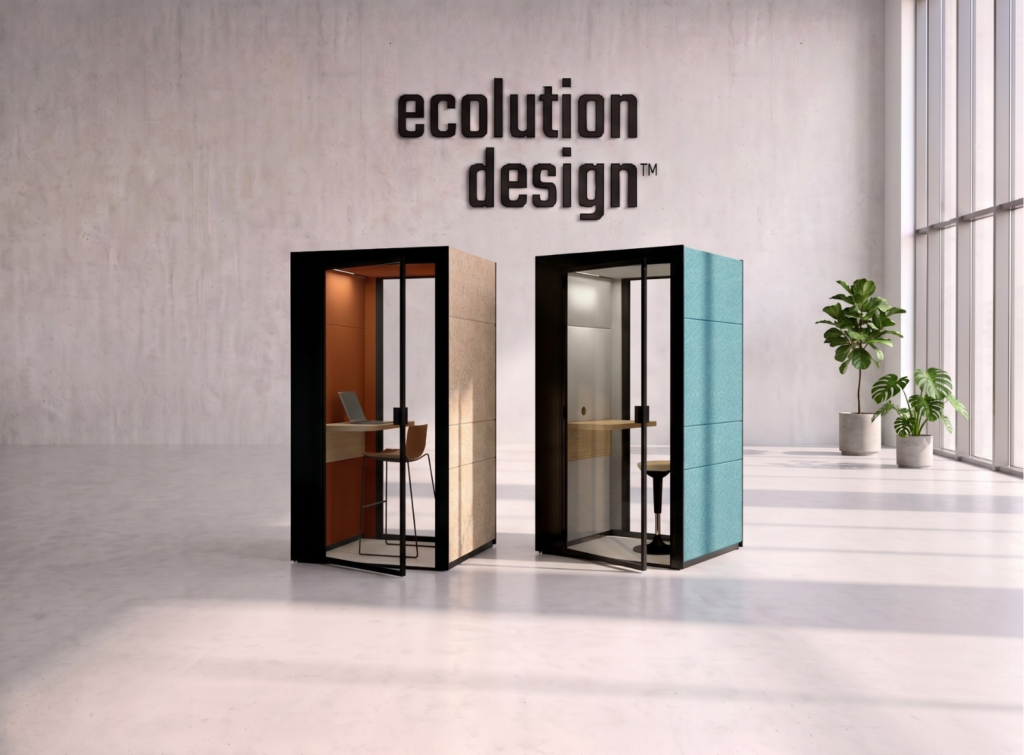
An office pod is not furniture, and it is not construction. It is a third category: a self-contained enclosure that delivers the acoustic performance, ventilation, and power infrastructure of a built room without a single permanent change to the building. A work pod sits directly on any existing floor surface, powers from a standard outlet, and moves when the floor plan changes. Unlike a conference room, it requires no permit. Unlike a partition screen, it actually contains sound. Let’s look at the situations where a pod earns its place.
Who Uses Office Pods and for What
Office pods serve four main users: solo workers needing focus, employees taking calls, small teams meeting, and open-plan or hybrid workplaces creating on-demand privacy. The right pod for each user depends on the task it must perform. Ecolution Design pods cover the full range, from single-user units up to a meeting pod that accommodates up to 12 people. The same units also adapt well beyond the desk, so it is worth reviewing the alternative uses for office privacy pods before you settle on a layout.
Solo Focus Work and Deep Concentration
A single-user pod is the right choice for solo focus work and deep concentration. The desk worker who cannot enter a flow state, because a colleague’s call three rows over is always audible, is the most common buyer. An Ecolution Design work pod uses sound-absorbing panels and a Class A acoustic rating to shut out more than 30 dB of ambient noise. That reduction drops a loud open-plan environment to near-silent from inside.
So a privacy pod for offices is not a perk. It is the infrastructure a knowledge worker needs to do the job the office hired them to do. Focus pods are especially valuable for neurodivergent staff who need a low-stimulation space.
Phone Calls and Video Meetings
A soundproof pod fixes both sides of a phone call or video meeting at once. It contains the speaker’s voice and also blocks inbound ambient noise. So the conversation stays professional regardless of what is happening three desks over. The client on the other end of the call no longer hears the open-plan background noise. The Class A acoustic rating is the standard to ask for when evaluating any phone booth for office use.
Small Team Meetings and Collaboration
A multi-person pod replaces a built meeting room for small team meetings and collaboration. Open-plan meeting areas have no acoustic containment, so a brainstorm or a status check becomes noise for everyone nearby. A modular Ecolution Design meeting pod delivers that containment without a permit or a contractor. The same enclosed setup also works well as a consultation space for healthcare teams.
When meeting pods are connected in series, acoustic and ventilation performance is fully maintained. So a multi-unit layout reads as coherent architecture rather than a collection of separate boxes.
Open-Plan Offices and Hybrid Workplaces
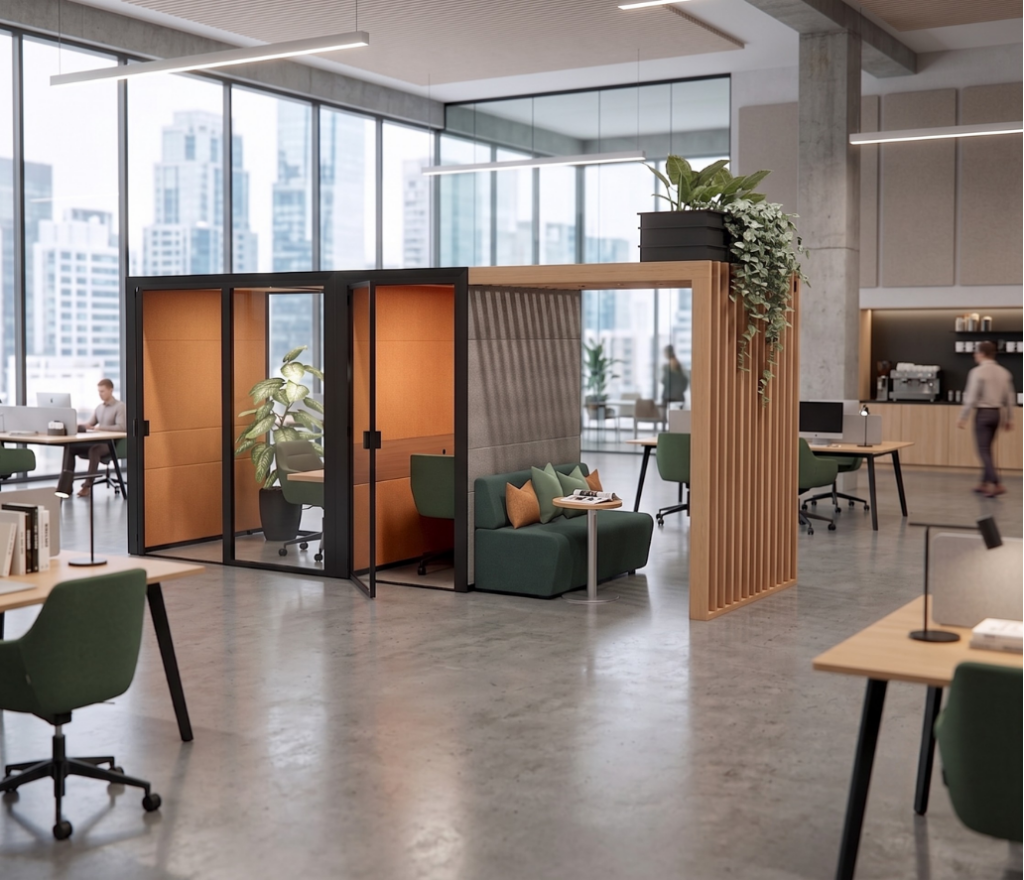
An office pod gives open-plan and hybrid workplaces on-demand acoustic privacy at the point of need. Open-plan offices were designed for collaboration, so focus and private conversation were never part of the brief. In a hybrid workspace, the problem multiplies. On-site workers compete for the few enclosed spaces, while remote participants deal with background noise on calls. So a privacy pod is not a room a worker books in advance. It is always available.
What to Look for When Buying an Office Pod
The four things to check before buying an office pod are acoustic rating, ventilation, accessibility, and modularity. Not all of them perform the same way. So a pod that solves the problem differs from one that creates new ones on each of these four points.
Acoustic Performance
A Class A acoustic rating is the highest available category for sound absorption. That reduction drops a loud open-plan environment to near-silent from inside. Sound-absorbing panels are the mechanism. Still, some pods marketed as soundproof carry no acoustic rating at all. So Class A is the standard to ask for explicitly, not to assume. A pod that relies only on marketing language rather than a rated enclosure is not acoustic. It is a box.
Ventilation and Air Quality
High-quality ventilation is essential in any pod used longer than a few minutes. A sealed acoustic enclosure traps heat and CO2 quickly without active ventilation. An Ecolution Design pod refreshes its air often, which keeps extended sessions comfortable rather than stuffy. So ventilation is not optional in an acoustic pod.
How to Choose the Right Office Pod for Your Situation
Choose a pod by headcount first, then primary use, then future flexibility. A single-user pod handles focus work and calls. A two-to-four-person pod handles team check-ins. A larger unit that accommodates up to 12 people replaces a meeting room.
Next, consider the primary use. A pod that hosts calls and video needs Class A acoustic performance and good lighting most. A pod that hosts extended focus sessions needs ventilation as much as acoustics, because a stuffy pod is an unused pod.
Finally, consider whether needs will change. An Ecolution Design pod offers 56 configurations from one interchangeable component system, so it reconfigures rather than gets replaced. Today’s single-user phone pod can become a two-person collaboration unit when the team grows.
An Ecolution Design pod is built on-site in less than a day, whereas a built room takes weeks. A single unit also requires no construction budget, no permit, and no downtime. So the case for an office privacy pod is not just acoustic. It is financial, and the return on a cost-effective pod adds up over time.
Why Ecolution Design Office Pods Perform Differently
Ecolution Design office pods are designed and manufactured in Grand Rapids, MI, with locally sourced materials and no overseas production. So a shorter supply chain means lower shipping emissions and faster lead times than any overseas maker can match. The Grand Rapids origin is a sustainability argument before it is an origin story. For a fuller comparison, see how office pods stack up against traditional construction on cost, time, and results.
Ecolution Design pods are made from up to 91% recycled materials and are 99% recyclable at end of life. Individual components are replaceable, so a damaged panel is a panel swap rather than a full-unit retirement. An Ecolution Design pod enters and exits the supply chain as urban mining output, not landfill.
An Ecolution Design pod offers 56 configurations from one interchangeable component system. It’s pod outlasts sealed-unit competitors on cost and environmental terms, because no single component failure forces a full replacement. Every Ecolution Design pod also carries a 10-year warranty.
ADA compliance is the default in every Ecolution Design pod. The no-floor design gives a 0-inch threshold, and the interior allows the 60-inch turning radius that is the ADA standard for full wheelchair manoeuvrability.
Frequently Asked Questions About Office Pods
How much noise does an office pod actually block?
Ecolution Design pods carry a Class A acoustic rating and shut out at least 30 dB of ambient noise. A 30 dB reduction drops a loud open-plan office to near-silent from inside the pod.
Can office pods be moved after they are set up?
Yes. Ecolution Design office pods are demountable and reconfigurable. A pod is taken down and rebuilt when the floor plan changes. The no-floor design requires no floor anchoring and leaves no trace on the original surface.
Are office pods ADA compliant?
Yes. Ecolution Design pods are ADA compliant by default.
What makes Ecolution pods different from other office pods?
Ecolution Design pods offer Class A acoustic performance, up to 91% recycled materials, 99% recyclability at end of life, 56 configurations from one component system, a no-floor design, and adjustable door direction across the full range. Ecolution Design is the only pod manufacturer offering left/right hinge and inward/outward swing direction.
What is an office pod?
An office pod is a self-contained acoustic enclosure that delivers the performance of a built room, including sound absorption, ventilation, and power, without permanent construction. It is a third category: not furniture, not a room.
The Office Pod Is Infrastructure, Not a Perk
An office pod is infrastructure for productivity and client experience, not a comfort perk. The problem open-plan offices created was a productivity and client-experience problem that furniture rearrangement has never structurally solved. Workers who cannot focus for 30 minutes without noise interruption are not underperforming. The office is underperforming.
It is the first architectural response that requires no construction, no permit, and no months of planning. As hybrid work becomes the permanent operating model, offices that cannot offer on-demand acoustic privacy will lose the workers who need to think for a living. The pods that exist in a building on a Tuesday morning will determine whether that building is worth commuting to. That is not a facilities question. That is a business decision.