

Greener Workplace: 30 Practical Steps That Pay Back
A greener workplace lowers running costs, cuts carbon, and gives people a space they actually want to come back to. The steps are practical and most pay for themselves. The hard part is not knowing where to start. It is turning a policy on paper into decisions the office runs on every day.
In this post, we'll take a look at:
What Makes a Workplace Greener (and Why It Pays Back)
A greener workplace uses less energy. It builds with lower embodied carbon. It wastes less, and it keeps the indoor environment healthy to work in. That is the whole definition, and every step below serves one of those aims.
The payback case is direct. Lower energy and waste bills return the fastest, because they show up on invoices you already receive. A healthier, quieter space reduces the friction that drives absence and turnover, costs that are real yet rarely tracked as a sustainability line. Carbon reduction has become a procurement and reporting requirement, because clients and investors now ask for the numbers.
A recycled poster on the wall changes nothing. A lighting system that stops burning power in empty rooms changes the bill every month. Sustainability and business performance point the same direction when the choices are structural rather than cosmetic. Treating green and quality as a trade-off is how good intentions stall.
Workplace sustainability matters most here because the office holds a company’s biggest recurring footprint. It is the space you heat, light, furnish, and refit year after year. That makes it the place where good decisions compound. Strong green practices are not a separate program bolted onto operations. They are the operations, chosen well.
Start With Energy Efficiency and Conservation
Energy is the largest recurring cost and the fastest measurable win, so it comes first. Fix this before anything else and the savings fund the rest of the plan.
Switch to LED lighting with occupancy sensors. The most common waste in any office is lighting empty rooms. Sensors end it. They dim or cut lighting when a space is unused.
Kill phantom and standby power. Devices left drawing power overnight add up across a floor. Smart power strips and outlet timers shut down monitors, chargers, and equipment when nobody is there, because a machine on standby still costs money.
Match HVAC and thermostat schedules to real occupancy. A fixed five-day default heats and cools a building that is half empty. This matters more as hybrid attendance varies day to day, so schedule to when people are actually in, then adjust as patterns settle.
Source renewable energy. A green tariff or on-site generation cuts operational carbon without touching how the office functions. Where the building allows it, this is one of the cleanest wins available.
Energy-efficient office design does not require costly rewiring. These are green office practices you can start this quarter, and the results are visible on the next bill. Everything from sensors to timers pays back fast.
Cut Waste and Design Out Disposal
The greenest waste is the item you never buy or never throw out. Start there, then work outward.
Put clearly signed recycling and composting where people actually decide, next to the bin they reach for by habit. Run a zero-waste break room with durable dishware instead of single-use cups and cutlery. Set up an e-waste and battery take-back route so old equipment leaves responsibly. Default to digital rather than managing printing, since the cleanest paper policy is the one that removes the paper.
The largest avoidable office waste is not the bin. It is the rip-and-replace refit. Every few years a floor plan changes, and the old fit-out gets torn out and landfilled. Modular, demountable furniture adapts instead. It comes apart and goes back together when the layout shifts, so the material stays in use. For a deeper look at this approach, see how repurposing unused spaces keeps existing floor area working.
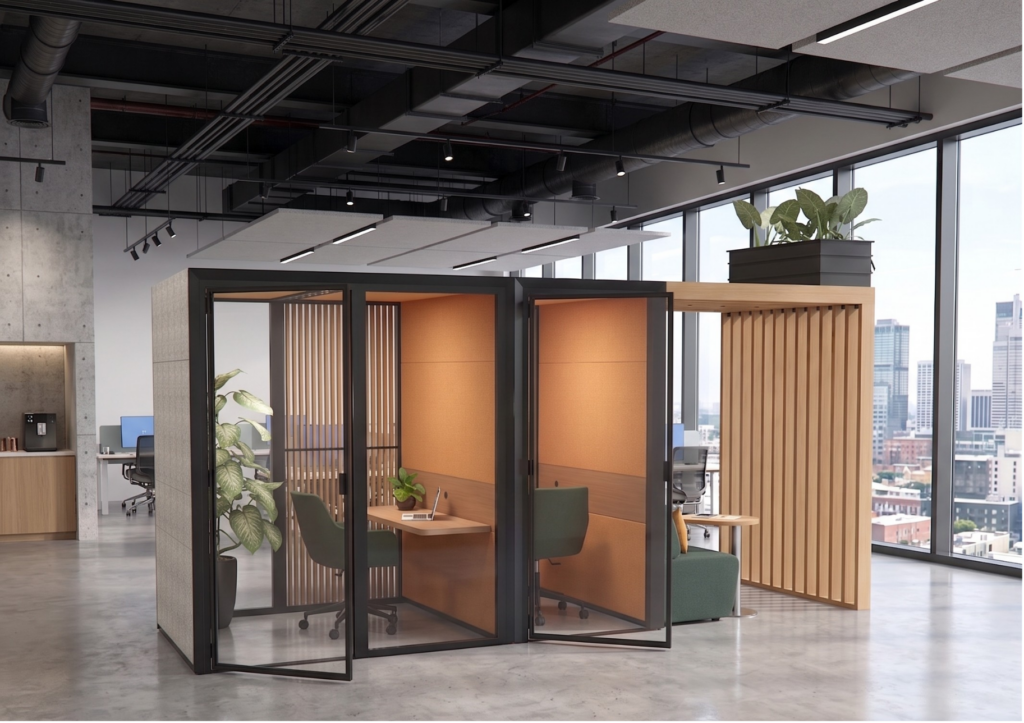
Our Ecolution Design pods are one lever here, not the whole answer. They are demountable, not portable. They come down and rebuild when the layout changes, and the no-floor design leaves no trace on the original surface. When our pods are connected in series, acoustic performance holds fully across the units. A connected run like that is fully reversible, no permanent structural change, no demolition waste. That is a floor plan reshaped without a wrecking bar.
We carried the same thinking to delivery. Our returnable crate packaging system means no single-use cardboard piling up on the loading dock. Design for disassembly runs end to end, and it treats a pod at end of life as a source of recoverable material rather than landfill. Our pods sit in a third category, neither furniture nor construction, which is why a floor plan can change around them without demolition. This is also why office pods beat traditional construction on cost, time, and waste.
Office furniture recycling starts with furniture built to be taken apart. Choosing green office products with that in mind is also what makes a sustainable work environment last past the next reorg.

Choose Sustainable Supplies, Materials, and a Circular Fit-Out
Prioritize reusable, recyclable, remanufactured, and second-hand supplies and furniture over new virgin goods. That single rule reshapes procurement, because it forces a question about what happens to an item after you are done with it.
Recycled content is necessary but not sufficient. What decides an item’s footprint is whether it can be repaired and reconfigured or simply becomes obsolete. Design longevity matters more than the material label. Ask what happens to a purchase in ten years, and the answer usually outweighs what it is made of today.
Our Ecolution Design pods carry that argument in numbers. They are made from up to 91% recycled content and are 99% recyclable at end of life. That is the full circular story, high recycled content in and near-total recyclability out. Modularity protects it over time. One interchangeable component system yields 56 configurations, so panels, glazing, fronts, and backs swap as needs change. A damaged or outdated panel is a panel swap, not a full-unit retirement. Nothing gets scrapped because one part aged. That is the logic behind circular economy office pods, where components stay in use instead of heading to landfill.
Where a product is made shapes its footprint too. Our pods are designed and manufactured in Grand Rapids, MI, with locally sourced materials and no overseas production. That means a shorter supply chain, lower embodied carbon in transit, and faster lead times. Local sourcing is a sustainability argument first and a domestic one second.
Embodied carbon is the carbon spent making and moving a product, while operational carbon is what it costs to run. A greener office weighs both. Sustainable office supplies and green office furniture that ship halfway around the world can carry more embodied carbon than their recycled content saves. Sustainable office chairs and desks earn their label when they last, repair, and reconfigure, not when they arrive with a recycled sticker.
Improve Indoor Air Quality, Acoustics, and Employee Health
Indoor environment quality is itself a green metric. A workplace where people cannot breathe well or focus is not well designed, whatever its carbon score reads.
Specify no-VOC or low-VOC paints and finishes so the air is not off-gassing at people all day. Switch to non-toxic cleaning products. Add plants and biophilic elements, and maximize daylight wherever the floor plan allows, because natural light does double duty for mood and energy use.
Acoustics belong in the same conversation. A quiet space is not a perk, it is infrastructure. A well-appointed office that is too loud to think in pushes people to work from home, which defeats the point of the space you invested in. Noise is a design failure, and it is a green one, because an office nobody uses is embodied carbon sitting idle.
Our Ecolution Design pods act as the acoustic lever. They are Class A sound-absorbing and shut out at least 30 dB of ambient noise, so a focused call or a quiet hour of deep work is available without leaving the building. Quiet, low-stimulation rooms also help, as our guide to neurodivergent spaces explains. Air refreshes continuously through high-quality ventilation, so the enclosure stays comfortable in use. This is one green metric among several, sitting alongside energy and waste, not standing in for them. A sustainable work environment and an eco-friendly office are the same office when air, light, and sound are all treated as part of the design. The space people actually occupy has to be the space that works.
Conserve Water and Rethink Food and Drink
Install low-flow faucets, aerators, and dual-flush or sensor fixtures, then fix leaks promptly. A dripping fixture wastes a measurable amount over a year, and the repair is cheap next to the running loss. These are small recurring savings, but they compound quietly.
Replace disposable cups, plates, and cutlery with reusable dishware. Provide filtered water on tap so single-use bottles disappear. Choose local, plant-forward, low-waste catering, and compost the scraps that remain. None of this is dramatic, yet it is one of the simplest ways to be green in the office, because staff feel the change without being asked to sacrifice anything. Small habits at the office kitchen add up faster than most teams expect.
Reduce Commuting Emissions With Flexible Work
Commuting is often the single largest slice of a company’s per-employee footprint, and it can be cut with no capital outlay. That makes it one of the highest-leverage moves available.
Anchor in-office days to collaboration, so the days people divide their time between office and home remove vehicle miles directly. Default to video calls over travel for meetings that do not require presence. Support greener commutes with EV charging, secure bike storage, cycle-to-work schemes, and carpool matching. Where the location allows, site near transit or subsidize passes so the greener trip is the easier one.
Structured or flexible remote arrangements are a direct carbon-reduction lever, not just a staff perk. Sustainable workplace practices treat the commute as part of the footprint, because it is. Workplace sustainability that ignores how people arrive misses the biggest number on the page.
Build a Green Culture and Engage Employees
Green practices decay without ownership. Someone, or some group, has to keep them active, or they fade into a page nobody reads.
Form a green team or name a sustainability lead with a real mandate and budget influence, not a title and no authority. Publish a short set of best practices staff can actually follow, then make the sustainable option the default and the easy one. Stock the reusable kit. Keep recycling visible. Set printers to print-off by default. Recognize and share wins so the behavior sticks and spreads.
The biggest lever is making the good behavior frictionless rather than relying on willpower or posters. People follow the path of least resistance, so move the resistance. Sustainability at work holds when the right choice is also the convenient one. The office sustainability ideas that survive a busy Tuesday are the ones worth keeping. This is how a green workspace lasts, by turning a policy on paper into how the office runs when nobody is watching.
Measure, Report, and Certify Your Progress
A greener workplace you cannot measure is a claim, not a result. Track baselines and report against them, or the whole effort stays a story you tell rather than a number you own.
Measure energy, water, waste diversion, and procurement footprint against a baseline year. Report progress in plain metrics staff and stakeholders can see, because a figure people understand is a figure people act on. Then bring in certification as validation. LEED, WELL, and B Corp give a documented, third-party frame, and the right way to treat them is as validation of real choices, not as the goal itself.
Teams that made good choices but cannot prove them cannot claim the credit. The evidence base matters as much as the decision. On our products, verified sustainability certification is available per product, which gives the material-level data that LEED submissions and ESG documentation require. That turns a good specification into a defensible one.
Sustainability initiatives live or die on whether the numbers hold up under a question. Green business practices become reportable the moment you can show the baseline, the change, and the proof behind it.
Frequently Asked Questions
What is the first step to a greener workplace?
Start with energy and waste, because they are the fastest measurable wins and show up directly on your bills. Fix lighting, standby power, and HVAC scheduling first. Then fold sustainability into every procurement decision, so each new purchase moves the footprint the right way. This is the most reliable way to begin, and it sets up a green workspace that keeps improving.
How does a greener workplace save money?
Lower energy and waste bills return the fastest and are the easiest to track. A healthier, quieter space reduces absence and turnover, which are real costs most teams never assign to sustainability. Modular fit-outs avoid the rip-and-replace refit expense when the floor plan changes. The savings come from the choices, and good green office practices make them recurring. See how cost-effective office pods stretch that return further.
Do greener offices require green certification like LEED or B Corp?
No. Certification like LEED or B Corp validates real choices, but the savings and impact come from the choices themselves. A workplace can cut energy, waste, and carbon without any badge on the wall. Certification proves the work to outsiders, which is useful, yet it is never the source of the result.
How can we make sustainable habits stick with employees?
Make the sustainable option the default and the easy one. Stock reusable kit, keep recycling visible, and set print-off defaults so the right choice takes no extra effort. Name a green lead with real authority to keep practices active. These moves work because they replace willpower with convenience.
A Greener Workplace Is a Decision You Make Once, Well
A greener workplace is not a poster on the wall or a single green initiative announced and forgotten. It is a set of design and procurement decisions made once, well, that keep paying back in cost, carbon, and how people feel about the space. Green is not a campaign, it is a specification.
The offices that stay green are the ones where the green choice became the default and the built environment was specified to adapt rather than be torn out. Sustainability in the workplace endures where it was designed in, not bolted on, where the fit-out bends with the floor plan instead of ending in a skip. Stop treating green as a program you bolt on and revisit once a year. Start specifying the structural version of every decision, and the returns arrive on their own, quarter after quarter.