Study Pods for Campuses and Libraries: A Guide
A student sits in a busy library at exam time, and there is nowhere quiet to think. Every open table carries a nearby conversation, a phone call, and the scrape of chairs. No amount of willpower turns that into the focus the moment demands. Study pods exist for exactly this gap. They drop a quiet study zone into a noisy room without anyone building a wall.
In this post, we'll take a look at:
The same problem lands on the other side of the desk. An instructor who needs a corner to advise a student or run a small tutoring session finds every room booked and every alcove occupied. Someone claimed the one quiet space on the floor an hour ago. A quiet room is not always available, and it is rarely free in the ten minutes you actually have.
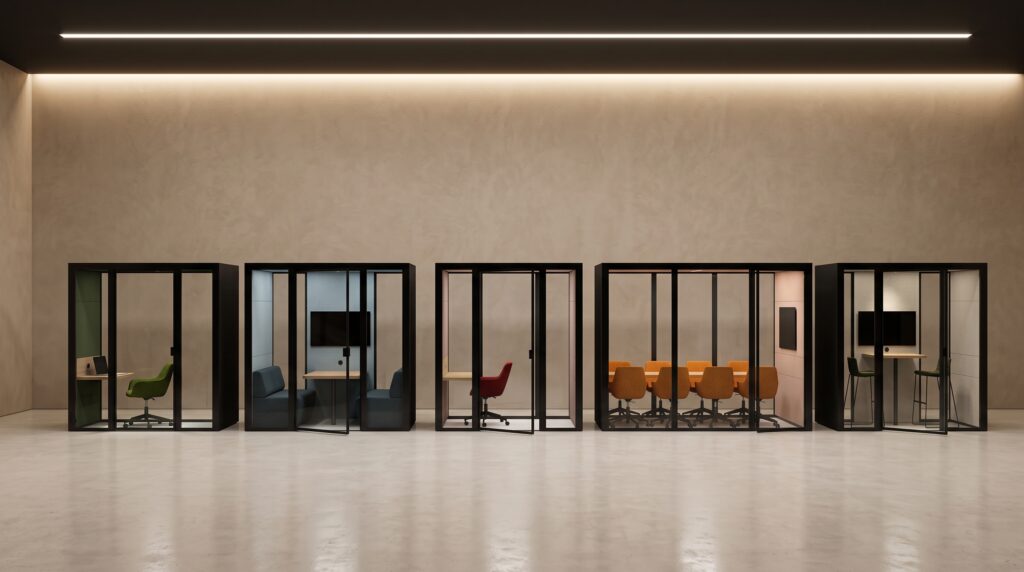
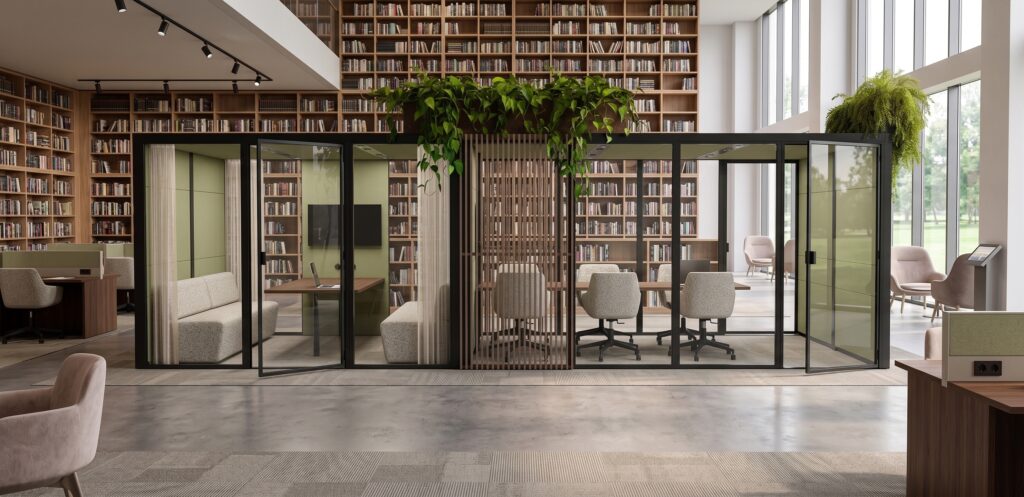
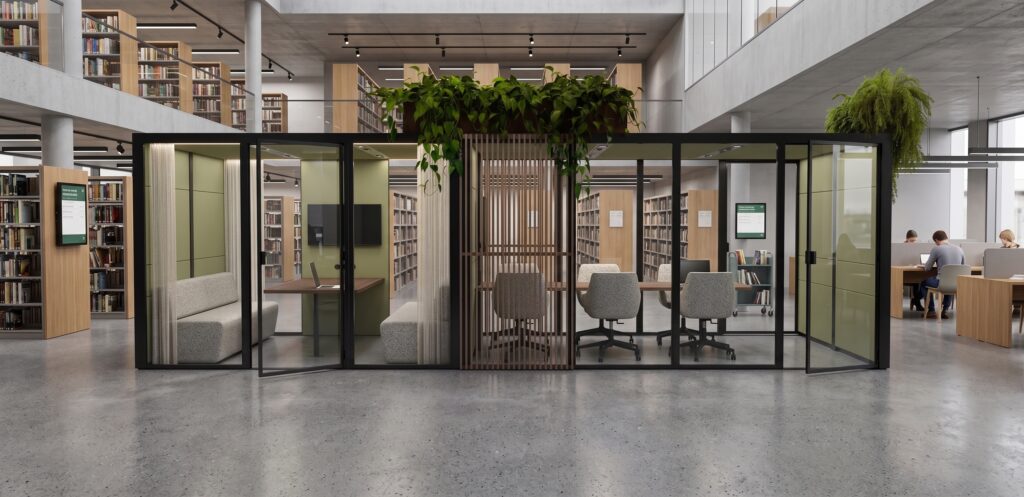
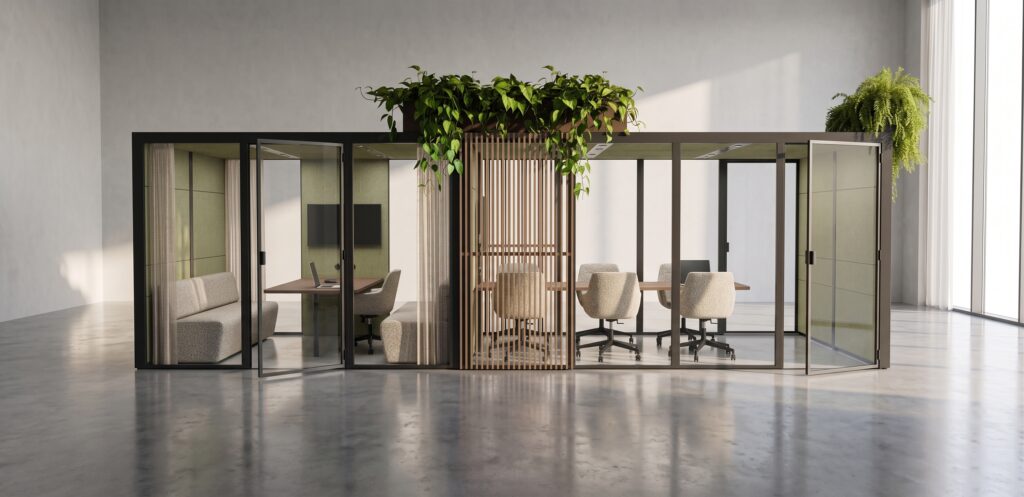
Study pods are self-contained, sound-absorbing enclosures that create a quiet study zone inside a noisy space. They range from single-user pods for solo focus to larger pods that seat a small group. They install without construction. A study pod gives a student on-demand quiet in a library or classroom. No permanent room has to be built to provide it.
A quiet space is not a perk on a campus. It is infrastructure. A student who cannot concentrate in a noisy library cannot manufacture quiet from thin air. Telling that student to try harder ignores the room they are sitting in. When study spaces are treated as something you hope stays free rather than something a building provides, focus becomes a matter of luck. Ecolution Design study pods design that luck out of the equation.
What Is a Study Pod?
A study pod is neither furniture nor construction. It is a third category. It delivers the acoustic performance and comfort of a built room without a permanent change to the building. That is exactly the gap most campuses fall into when they weigh their options.
Consider the two things people usually reach for. One is a built study room. It is slow to deliver, permanent once poured, and dependent on a floor-plan change that has to survive a facilities committee. The other is a basic booth or a screen. It is fast to buy but unable to actually contain sound. The person inside still hears the room, and the room still hears them. A study pod sits between those two. It behaves like a room for the person inside it while leaving the building untouched.
A few names describe the same idea. A single-occupant enclosure gets called a study booth, a study room pod, or a studio pod. The label depends on who is describing it. A pod built for privacy is sometimes just a privacy pod. The labels shift. The principle does not.
How Study Pods Block Noise and Protect Focus
Study pods block noise by containing sound around the person. A Class A pod shuts out at least 30 dB and protects focus. Noise in a library is not a background annoyance. It is a tax on comprehension. In an open reading room or a shared classroom, a nearby voice pulls at a student’s attention every time it registers as speech. Reading, testing, and writing all degrade under that constant reset. The cost is not that the room is loud. The cost is that concentration keeps starting over.
This is where the acoustic credential does the work. Ecolution Design pods are Class A sound-absorbing and shut out at least 30 dB of ambient noise. From the inside a busy library drops to near-silent. Speech privacy works the same way in reverse. Someone standing outside can tell a conversation is happening. The words do not carry far enough to make out.
There is a distinction worth holding onto, because it separates a pod from a panel. A wall panel softens echo by absorbing reflections. That makes a loud room less harsh. A pod contains sound around the person, so the space around them stops reaching them at all. Good workspace design supports both focused and diffuse thinking. The pod handles the focused end of that range, the heads-down mode where interruption is the enemy. For a deeper look at how controllable environments serve different minds, our piece on designing sensory-considered spaces covers the ground.
Where Study Pods Work: Classrooms, Universities, and Libraries
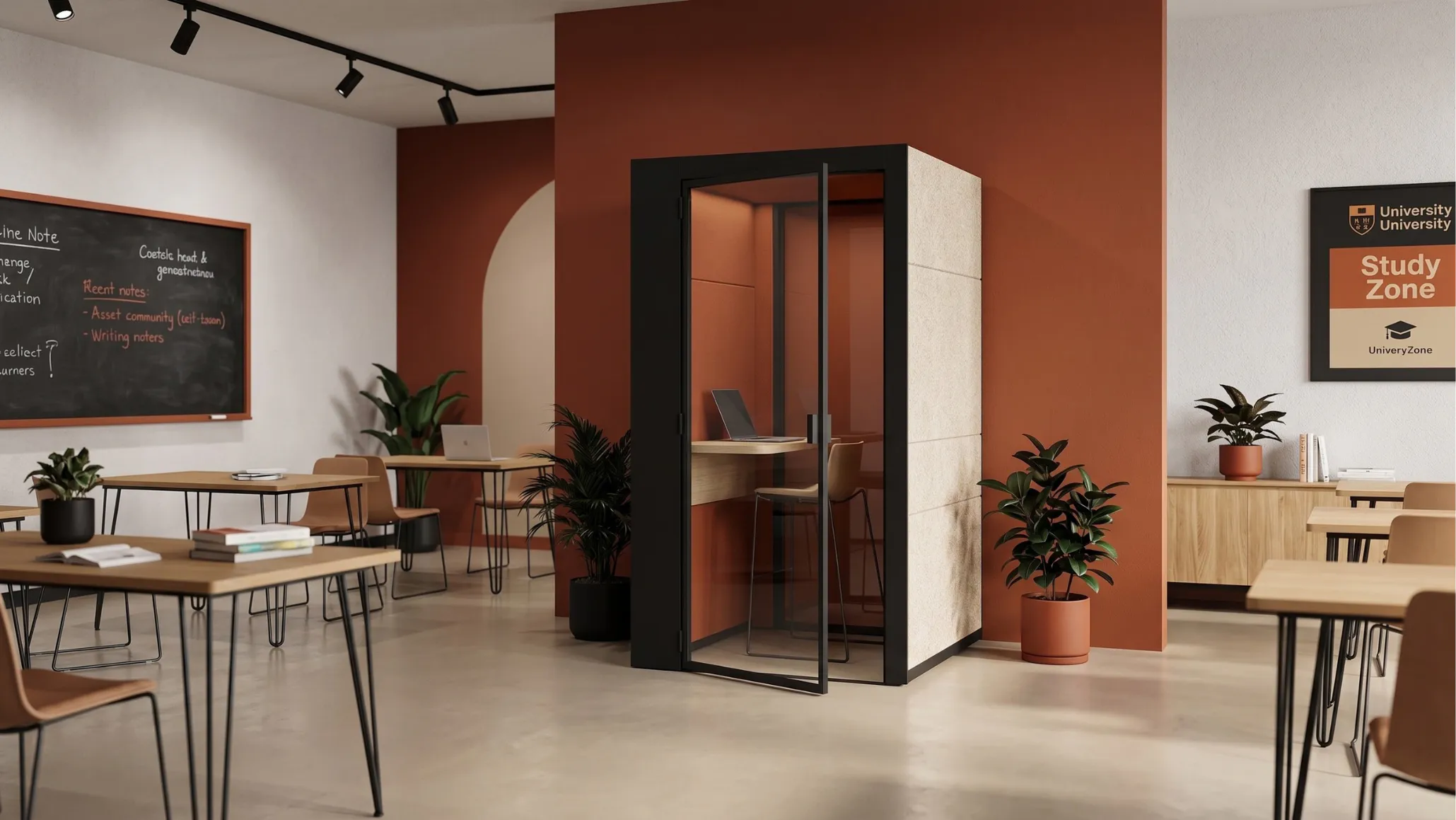
Study pods work in libraries, universities, and classrooms because they deliver quiet exactly where high traffic and focused work collide. Libraries run on a contradiction. They are high-traffic and open by design. Yet the people inside them need private, uninterrupted focus. Those two demands collide at exactly the tables where students want to work. A single-user pod resolves that conflict. It gives on-demand quiet study without booking a room days ahead. Ecolution Design installed pods for a University that provide on-demand privacy in its busiest campus buildings. The quiet appears when a student needs it rather than when a calendar allows it. That is the difference between a scheduled study room and on-demand privacy. On a crowded campus it is the whole difference.
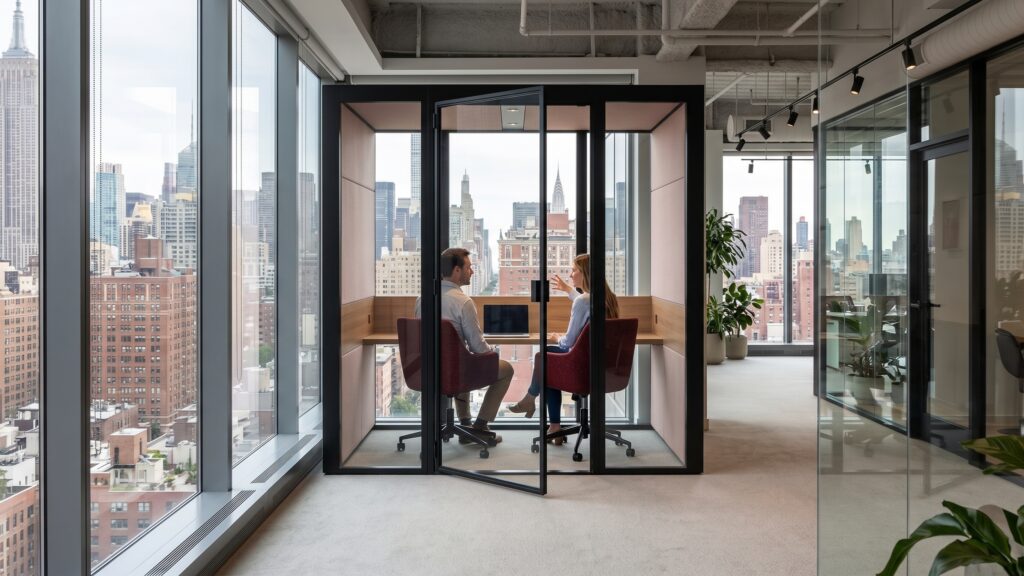
Universities carry a wider range of study spaces than any single pod size covers, and that is the point. A tutoring pair needs a contained space where two people can talk without disturbing a floor. A small pod handles that. Group study and small-group instruction need more room. Accessibility is not a separate track here. The no-floor design sits flush with the existing floor, with no threshold to cross. A student who uses a wheelchair can move straight in rather than being stuck with the pod shoved into a corner. Accessibility has to be designed in from the start, not retrofitted. A pod that works for everyone is simply a better pod. When a campus is rethinking how it uses square footage it already has, repurposing underused spaces is often where a pod program starts.
Study Pods in Classrooms and Schools
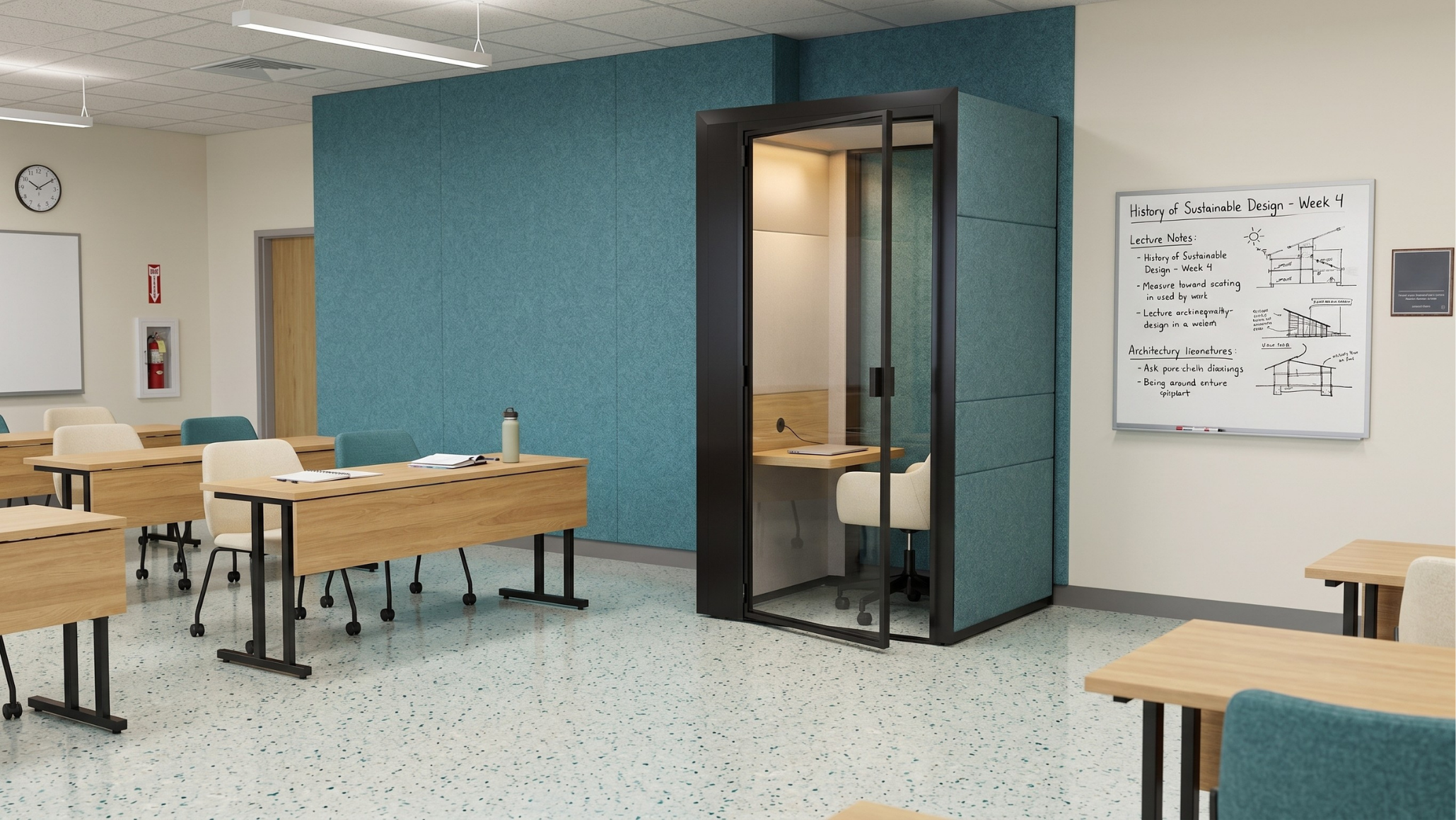
Classrooms and schools have their own version of the problem. A teacher needs a quiet corner for a student taking a test in a different format, a learning pod for a handful of students working through a group task, or a place to advise one student without emptying the room. School pods hold up here. They create the quiet locally, right where the work is happening. A shared classroom stays usable for everyone else.
Benefits for Students and Institutions
Study pods give students focus that holds and give institutions a better building without a build-out. The value reads differently depending on who is standing in front of it. A student feels it as focus that finally holds. A facilities director sees it as a better building without a build-out. Both are real. Inclusion is a spatial design problem as much as a policy one. Accessible, quiet study zones are what let students with different needs actually perform rather than just feel welcome.
Focus, Quiet Study, and Academic Performance
A student who can retreat into a quiet study zone reads, writes, and tests better. Every nearby voice stops resetting his attention. That is the mechanism, and it is a plain one. The pod is not the whole answer to how a campus should be designed. It handles the focused, heads-down mode. A campus still needs open collaborative space for the work that thrives on people bumping into each other. Both matter, and the pod owns one of them completely.
Neuroinclusion is a performance factor, not a wellness afterthought. A controllable, low-stimulation environment is a baseline need for neurodiverse students, not a luxury laid on top. Framing that environment as comfort undersells what it actually does. A study pod enables performance. It lets a student who cannot filter a noisy room do the work the room was supposed to be for. A long study session stays comfortable rather than turning stuffy. That matters when people are settled in for real work rather than a quick sit-down.
What Institutions Gain: An Elevated Space Without the Build
For facilities teams and space planners, a study pod raises the quality of a library or academic building without a build-out, a permit cycle, or closing a floor for weeks. It fits the existing floor plan and adapts when priorities change. Today’s investment stays useful as the program grows and the needs shift under it. That is the argument for pods over construction on any campus running to a budget cycle. Our look at the economics of pods versus permanent build-outs walks through it in full.
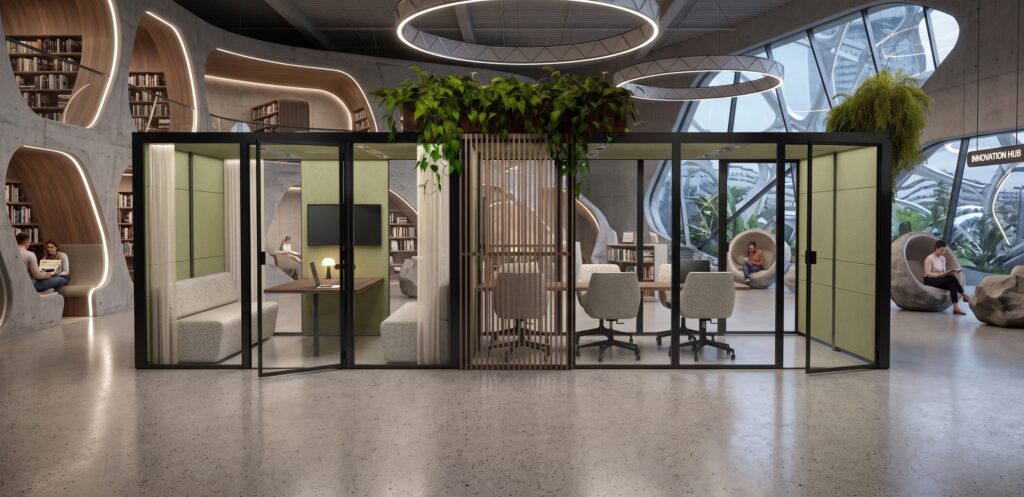
There is a finish question too, and it matters more than it sounds. Pods come in a wide range of fabric and customizable interior and exterior finishes. The pod reads as part of the campus rather than as a temporary box parked in a reading room. A study space that supports focus today and flexibility as needs change earns its place. One that looks like it is passing through does not.
Choosing the Right Model and Size: Individual vs Group Study Pods
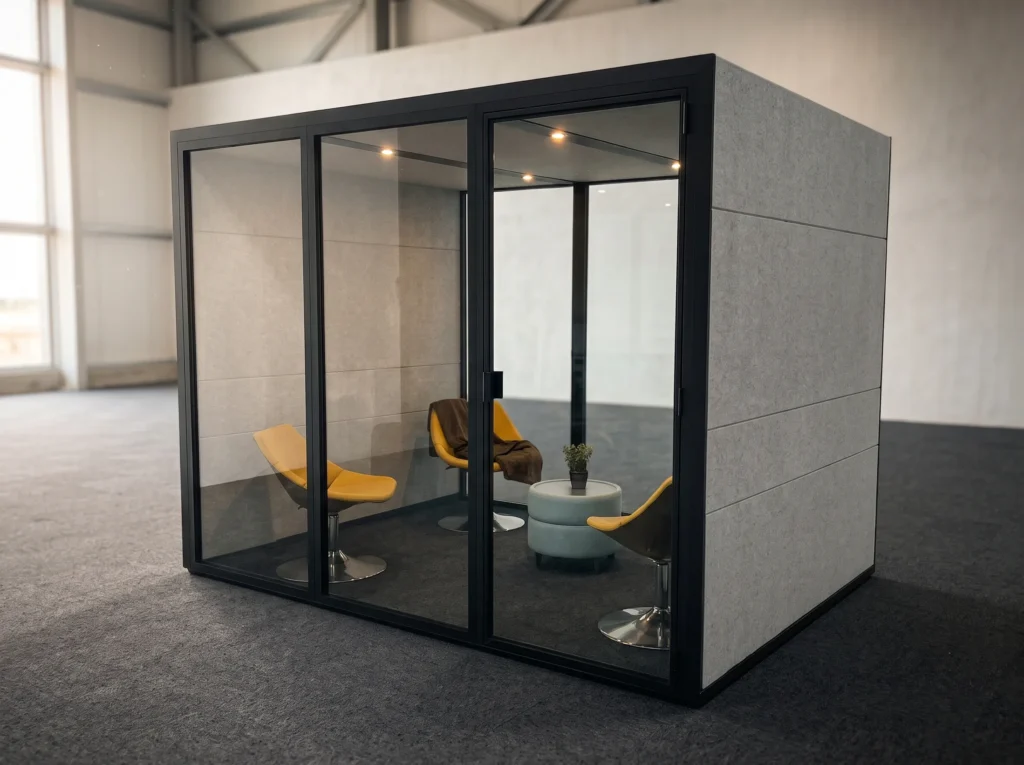
Match the pod to the task, not the task to the pod. Solo focus needs an enclosure built for one. An individual single-user study pod handles silent, heads-down work at a single desk. It holds Class A acoustics and shuts out at least 30 dB of noise. Tutoring needs room for a pair or a few. A small study pod seats two to four people for tutoring pairs and small study groups. It holds the same Class A rating in a compact footprint. Group study and small-group instruction need more space again.
The point that surprises people is what happens when pods connect. When pods join in series, the acoustic performance holds fully across the units rather than degrading at the joins. That is what lets a campus scale a program without trading away the thing the pods were bought for. An acoustic pod that only works alone is a different, weaker product.
Installing Study Pods Without Construction
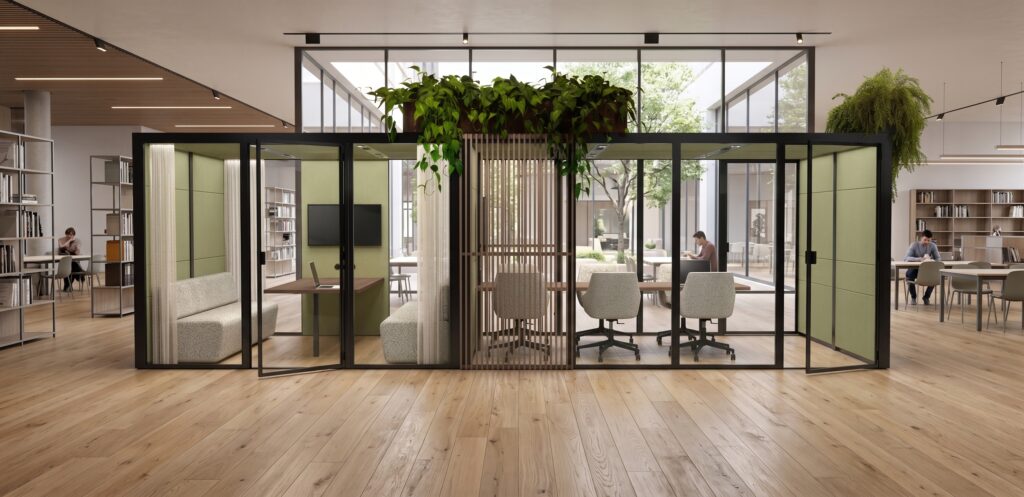
A study pod is built on-site in less than a day and connects to a standard power outlet. There is no floor prep. The no-floor design sits flush with any existing finish, with no threshold, no trip hazard, and nothing to demolish afterward. That is the entire installation. It is the reason a pod is not construction even though it performs like a room.
Placement is where the planning actually pays off. Put pods where the flow-versus-focus conflict is worst: near the entrance of a reading room, at the edge of an open classroom, along a busy corridor of a student union where foot traffic and the need to concentrate keep crossing paths. Because pods are demountable, they relocate when the floor plan changes. A pod added for exam season in one building can move to a new wing next year without a demolition invoice attached.
This is the on-demand-versus-booked distinction made physical. A study room is something a student reserves days ahead and hopes still fits their schedule when the day arrives. A study pod is quiet space that is simply there when needed, infrastructure rather than a reservation. A campus can scale that infrastructure with several connected pods that read as coherent architecture rather than a row of boxes. On a recent commercial office project, multiple pods of different dimensions were connected in series across an existing floor plan. Acoustic and ventilation performance held across the units, and nothing about the building permanently changed.
Why Ecolution Design Study Pods?
Our answer to the campus quiet problem is documented rather than asserted, so this section is proof rather than pitch. In our experience the questions that decide a purchase are narrow: does the acoustics claim hold, does the product last, and where is it made. Here is where we stand on each.
Sound Control That Meets Class A
Our full pod range is Class A sound-absorbing. At that rating a study pod shuts at least than 30 dB and drops a busy library or classroom to near-silent from the inside. Speech privacy is the documented outcome that follows. From outside a pod you can tell someone is talking, but the words themselves do not reach you. That is the credential the rest of the design is built to protect.
Built for a Circular Campus
Our pods are up to 91% recycled content and 99% recyclable at end of life. They are designed for disassembly, so components separate and recover individually rather than heading to a landfill as one welded mass. Materials matter, but they are necessary rather than sufficient. The question a campus should actually ask is what happens to the pod in ten years. The honest answer depends on longevity, not just recycled input.
This is where “modular” stops being a brochure word. The pods are built from one interchangeable component system that yields 56 configurations. Panels, glazing, fronts, and backs swap or replace individually. A damaged or dated panel is a panel swap, not a new pod. A study pod that reconfigures and relocates does not hit a strict expiration date and quietly become obsolete. It adapts instead. The returnable crate packaging means no single-use cardboard waste arrives with the delivery. The full circular case sits in our piece on the circular economy behind office pods.
Made in Grand Rapids, MI
We design and manufacture in Grand Rapids, MI, with locally sourced materials and no overseas production. The first reason that matters is not the flag. It is the supply chain. A shorter chain means lower shipping carbon and faster lead times. Faster lead times let a school hit a term or semester deadline instead of waiting on a container. Made in USA is a sustainability argument before it is a patriotism argument. For public-sector and Buy American procurement, the domestic manufacturing is simply the requirement met. The Business and Institutional Furniture Manufacturers Association maintains the sustainability and performance standards that domestic manufacturers like us build against.
Study Pods: Frequently Asked Questions
Are study pods soundproof, and how much noise do they block?
Study pods are Class A sound-absorbing and shut out at least 30 dB of ambient noise, so a busy library goes near-silent from inside. Someone standing outside can tell a conversation is happening but cannot make out the words. The pod contains the sound around the person rather than just softening echo in the room.
Can students book a study pod like a study room?
A pod can be scheduled if a campus wants it that way. Its real advantage is being available on demand. It is quiet space that is simply there when a student needs it, not a room reserved days ahead and hoped for. That on-demand quality is what separates a pod from a bookable room.
Do study pods need construction, permits, or special wiring?
No. A study pod is built on-site in less than a day and connects to a standard power outlet, with no floor prep and no build-out. The no-floor design sits flush with the existing finish, so there is nothing to demolish when a layout changes and the pod relocates.
Quiet Study Is Infrastructure, Not a Corner You Hope Stays Free
Campuses treat quiet as luck: a corner that happens to be free, a study room that happens to be open, a slow week when the library is not full. That works until exams, and then it does not work at all. The truth underneath the scramble for tables is simpler than it looks. Quiet study is something a building can be designed to provide on demand, not a resource students have to compete for. A student who cannot concentrate in a noisy library was never the problem. The building was.
Stop rationing quiet by chance. Start treating study pods as part of the learning environment itself. Our team would welcome a conversation about the right pod mix for your libraries, classrooms, and study spaces. We can help you find where quiet study zones would do the most for the students already sitting there trying to focus.