Office Pods: The Complete Buyer’s Guide to Types, Sizes, Acoustics, and Cost
Office pods are self-contained enclosures that add room-level quiet, ventilation, and power to a floor without construction. This guide walks through the types, sizes, sound ratings, features, and buying criteria that separate one pod from another. The problem they solve is familiar. The office is full, yet there is nowhere to take a call. Every enclosed room is booked by 9:30. The open floor carries every voice across three rows. Work that needs quiet gets pushed home or dropped. When quiet runs out that fast, the office is underperforming, not the worker.
In this post, we'll take a look at:
What Is an Office Pod?
An office pod is a self-contained enclosure that delivers a built room’s acoustic performance, ventilation, and power without permanent construction. That makes an office pod a third category, neither furniture nor construction. Furniture cannot give you speech privacy or refresh the air. Construction needs walls, a permit, and downtime. An office pod removes the false choice between performance and flexibility. You get both in a single unit. The pod rests on the existing floor. It draws from a standard outlet. It comes apart again when the layout changes. The first real decision is which type of office pod you need.
Types of Office Pods: Phone Booth, Focus Pod, Meeting Pod, and Room Pod
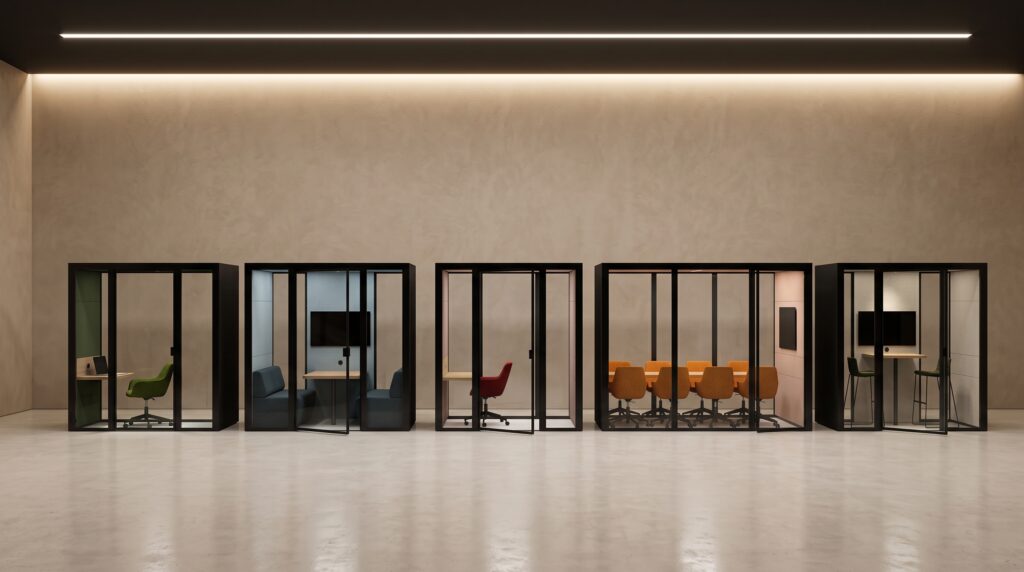
Office pods come in four practical types, and the right one is decided by how many people use it and what they do inside.
| Pod type | Capacity | Best for |
|---|---|---|
| Phone booth / single-user pod | 1 person | Private calls, quick video, heads-down bursts |
| Focus (work) pod | 1-2 people | Deep individual work, longer sessions |
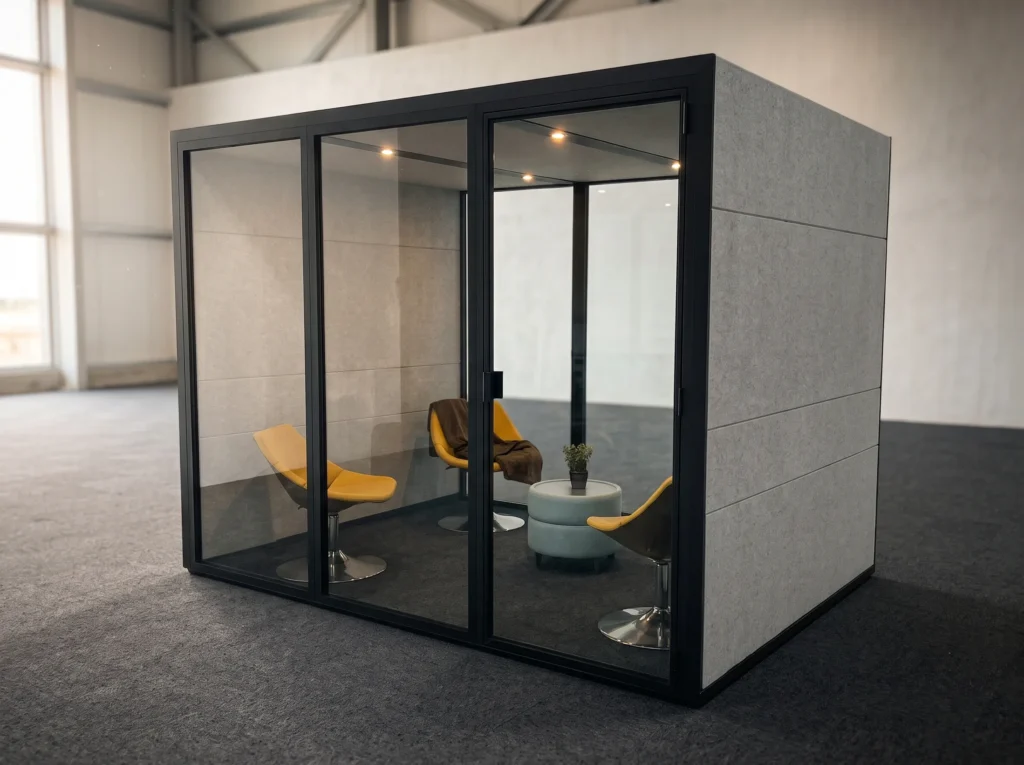
| Meeting pod | 2-6 people | Small team sessions, huddles, interviews |
| Room / team pod | Up to around a dozen people | Room replacement, workshops, connected-series layouts |
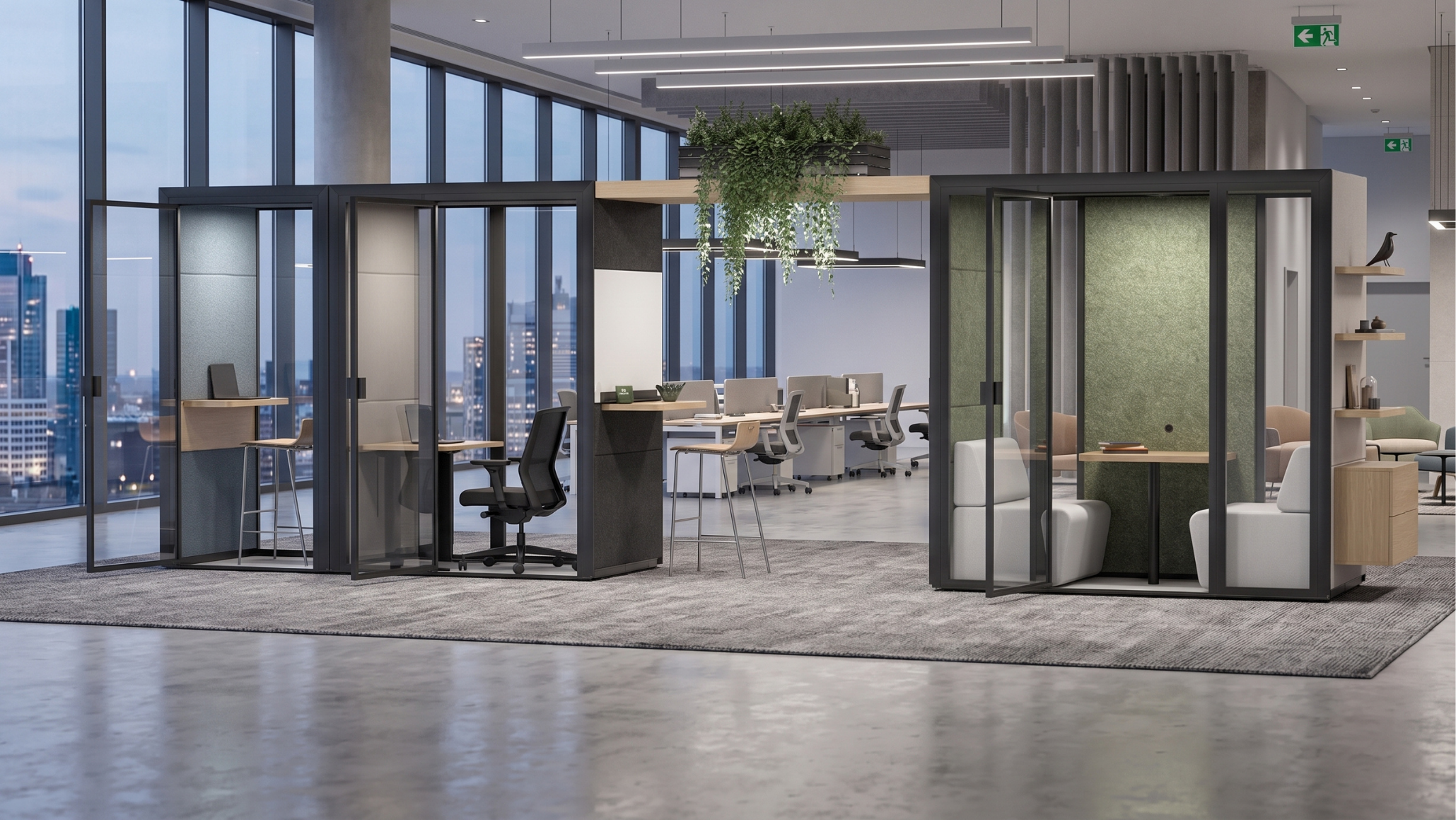
Every type shares the same Class A acoustic and ventilation build, so stepping up in size never steps down in performance. A single-user office phone booth and a meeting pod are engineered to the same acoustic class. A larger footprint comes from connecting pods in series rather than settling for a weaker box. That is how a work pod grows into a full conference room replacement. For a small team that keeps colliding over the same corner, the meeting end of the range covers the huddle room job without a construction schedule. The acoustic pod, the office meeting pod, and the modular office pod all belong to one system rather than four separate products.
Office Pod Sizes and Layouts: Matching Capacity to Use Case
Size selection starts with headcount, then use case, and everything else follows. A one-person phone booth handles private calls and quick video. A focus pod gives one or two people a place for deep work that runs longer than a call. A collaboration pod seats a team for a working session, and a connected pod replaces a small conference room outright, up to around a dozen people.
Floor space is usually the next question. A phone booth tucks into a corner or the dead space beside a stairwell. A collaboration pod wants clearance on the door side so people can move in and out without a bottleneck. A connected pod needs the footprint of the meeting it replaces, no more. The no-floor design sits flush with the existing floor finish. There is no threshold, no ramp, and no trip hazard where the pod meets the floor. The pod is fully ADA compliant.
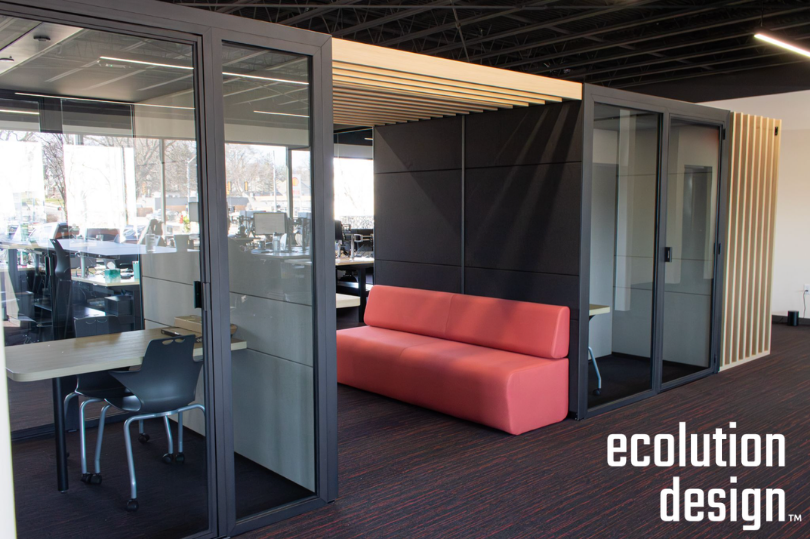
When a single unit cannot hold the layout, multiple pods link in series to form a bigger room or a run of connected zones. That is where office pods stop being objects on the floor and start shaping it. Plan the placement against your office floor plan and your broader modular office strategy, and the office privacy pod drops into the map cleanly.
Acoustic Performance and Soundproofing: What Class A Really Means for Office Pods
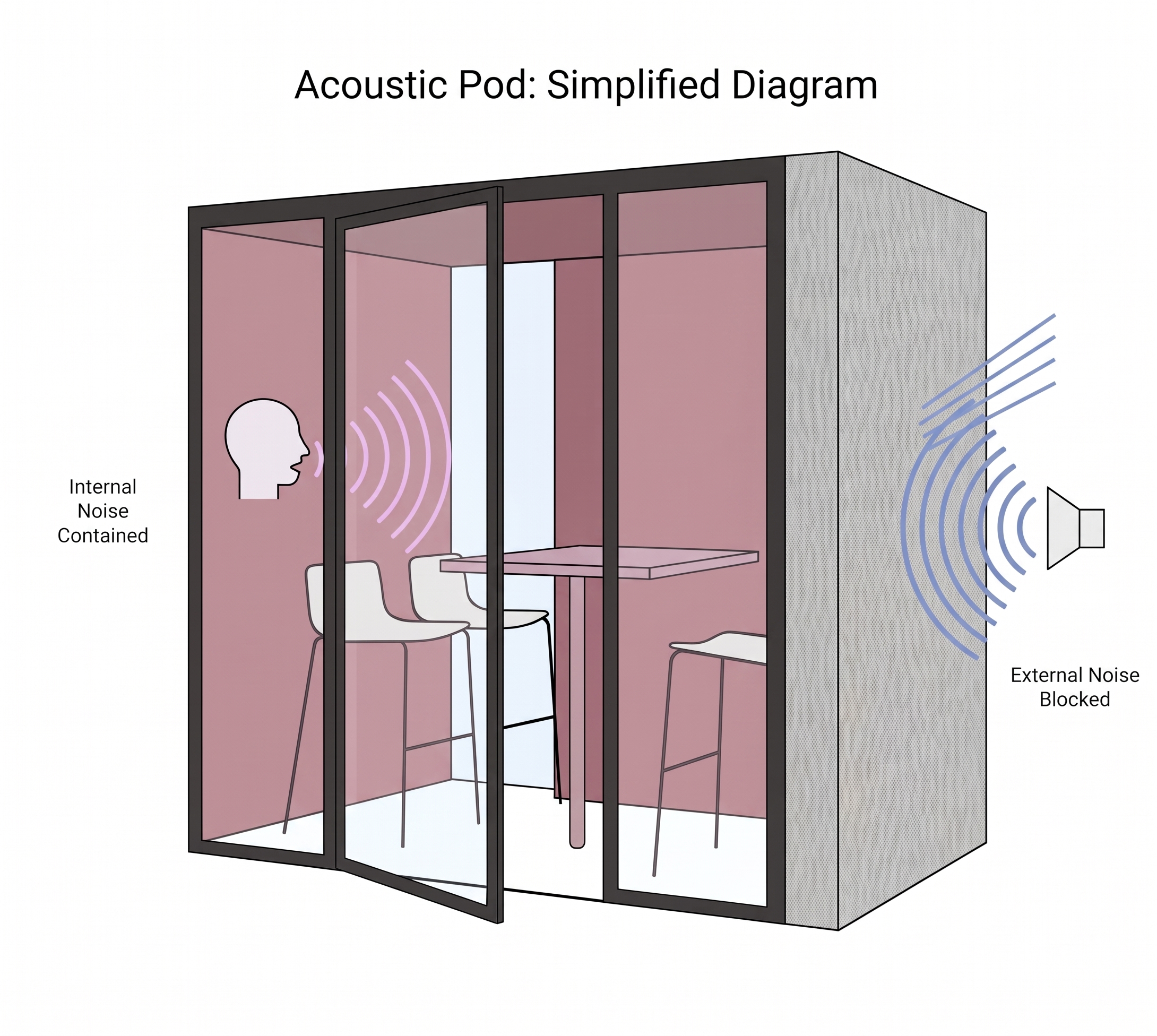
A Class A rating means the office pod shuts out at least 30 dB of ambient noise, and 30 dB is the floor, not the ceiling. A Class A rating buys speech privacy in both directions. Someone standing outside can tell a conversation is happening but cannot make out the words. From inside, the floor drops to near-silent. That is the difference between a box that looks enclosed and one that performs enclosed.
Acoustics is where most buyers get misled. The Class A DsA rating is tested as a complete enclosure, not a single panel. A panel rating tells you how one wall behaves in a lab. It cannot tell you how the whole pod performs once you add a door, a glass front, a seam, and a ceiling. Only an enclosure-level number describes the product you actually sit in.
Two jobs happen at once inside an acoustic office pod, and good soundproof office pods do both. Absorption keeps the inside calm, so your own voice does not bounce back at you and a call sounds clean. Containment stops that voice leaking out onto the floor. A pod that only absorbs feels nice inside and still disturbs the room. A pod that only contains is quiet outside and exhausting within. Acoustic office pods have to manage both.
The buying-literacy line is simple. When you compare acoustic office pods, ask for the acoustic class first, and treat any decibel figure as a floor rather than a peak. If a supplier quotes a single panel number and no enclosure test, you are reading a lab result, not a product spec. The mechanics of absorb-versus-contain are the same ones at work in acoustic wall panels and sound-dampening panels, and understanding them is most of what separates real office noise reduction from a quiet-looking shell.
Privacy for Calls, Video Meetings, and Focused Work
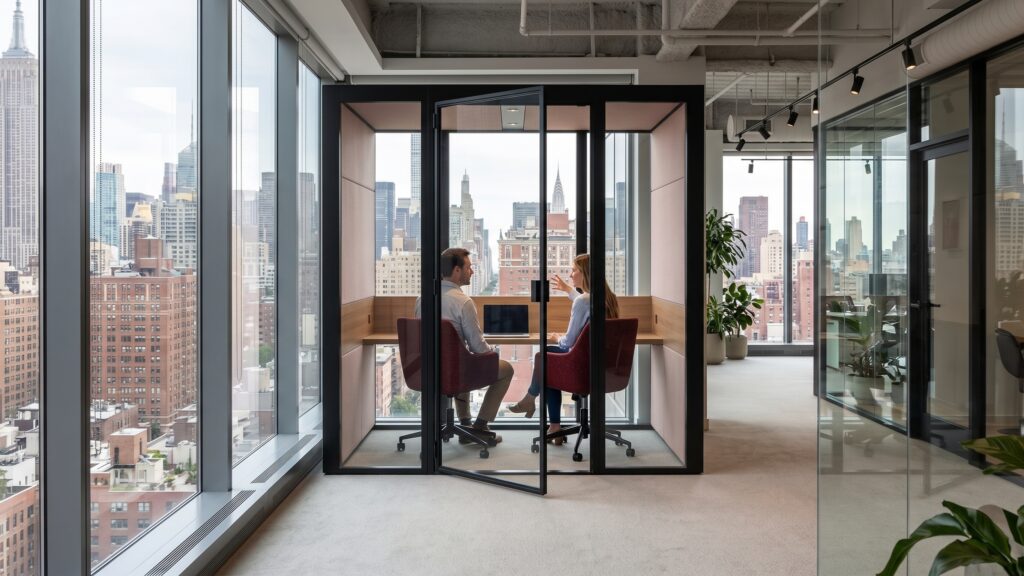
An office pod fixes both sides of a call at once. The pod contains the speaker’s voice so the floor is not disturbed. The pod blocks inbound noise so the caller sounds clean and professional. That second half is the part buyers underrate. On an open-floor call, the person on the other end hears your office too. The printer, the laughter two desks over, the meeting that started late all reach the line. A client forms an impression from all of it. An office pod removes that from the line entirely. The call sounds like it came from a private room because it did.
There is a scheduling argument too. A bookable room has to be reserved. On busy anchor days that room runs out, which is exactly when people need quiet most. An office privacy pod gives one person a quiet place without booking anything, so on-demand privacy replaces a calendar scramble. In a recent commercial office project with no dedicated space for calls or focused work, Ecolution Design pods gave the team quiet places to take a call, join a virtual meeting, and refocus between them. The floor did not change. The ability to step out of it did. That is what an office privacy booth is really buying, and it is why a single office phone booth can change how a whole row works.
Key Features: Ventilation, Lighting, Power, and Seating
Ventilation, light, and power decide whether an office pod is usable for a full workday. Acoustics get a buyer in the door, but these features keep the pod in use. Start with air. High-quality ventilation refreshes the air inside the pod every 2 minutes, so the fortieth minute inside feels as comfortable as the first. Nobody cuts a meeting short to escape a stuffy box.
The light is bright enough to read a document and easy enough on the eyes for a long video call. Power connects to a standard outlet, so a laptop and a monitor run without a special feed. Seating and the desk surface are sized for real work rather than a token perch. The glass fronts keep sightlines open so the pod reads as part of the room instead of a closed-off cell. Those details turn a phone-call closet into a place where an office pod earns a full day of use, and they are the reason a work pod gets used rather than avoided.
Modular, Freestanding, and Movable Design That Fits Any Floor Plan
Office pods are demountable, not portable, and the distinction matters. Demountable means the pod comes apart and rebuilds when the floor plan changes. A demountable pod is not something you drag across the office intact and jam into a new corner. When an office pod moves, it leaves no trace on the original surface. The no-floor design sits flush with any floor finish and adds no threshold. Every Ecolution Design pod is fully ADA compliant by default, so accessibility is the standard build rather than a special order.
The modularity is concrete, not a slogan. Panels, glazing, fronts, and backs swap or replace individually across 56 configurations from a single interchangeable component system. Nothing forces a full-unit replacement when one part needs to change. You change the part. Door direction is adjustable, so the opening lands where the layout needs it. Ecolution Design is the only pod manufacturer offering adjustable door direction. Connected in series, pods create zones and flow without permanent construction. Acoustic and ventilation performance holds across the connected units, and the run stays fully reversible. This is where an office pod stops being furniture and starts doing the work of architecture.
Customization: Interior and Exterior Finishes
True customization on an Ecolution Design office pod covers both the inside and the outside of the pod, not just a color swatch. A wide range of fabric options lets the interior finish and the exterior finish both match the brand environment instead of fighting it. A pod dropped into a considered space should look like it belongs there, not like a beige appliance parked by the window. Fit an Ecolution Design pod to the rest of your commercial interior design and the modular office pod reads as part of the room.
Delivery, Assembly, and Lead Times
A pod is built on-site in less than a day and connects to a standard power outlet. A built room takes weeks, a permit, and construction downtime that shuts a corner of the office while it happens.
| Office pod | Built room | |
|---|---|---|
| Install time | Less than a day | Weeks |
| Permit | None | Required |
| Downtime | Minimal | Construction disruption |
| Reversibility | Demountable, no floor trace | Permanent, demolition to undo |
The no-floor design needs no floor prep, so nothing has to be cut, cured, or leveled before the pod goes in. Delivery arrives in returnable crate packaging, so a single-use cardboard cleanup is not part of the job. That speed and cleanliness is the practical case for office pods over a construction quote when the need is quiet, not a new wing.
Employee Wellness, Focus, and Productivity
The first return on an office pod is work getting done and clients hearing a clean call. Wellbeing follows from that. In an open-plan office a quiet space is not a perk. A quiet space is infrastructure, the thing that makes the floor function rather than a wellness bonus bolted on afterward. When people can find quiet on demand, the deep work stops migrating home and the calls stop leaking into the room.
Good workspace design supports both heads-down concentration and the looser, diffuse thinking that solves the harder problems. An office pod is one part of that spatial strategy rather than the whole of it. The point is not that a box makes people smart. The point is that a floor with only one mode, open and loud, starves the other kind of thinking. Give people somewhere to close a door and the whole range of work has a place to happen. That is exactly what a hybrid office needs when attendance is uneven and every quiet seat is contested. That is the productivity case for office pods, and the wellbeing case rides along with it.
Durability, Sustainability, and ESG Value
Quality and sustainability are not a trade-off in an Ecolution Design office pod. The same pod delivers high acoustic performance and a strong environmental story, and the quality comes first. A pod that lasts and adapts is the point, and the materials story supports it. Ecolution Design pods are made from up to 91% recycled materials and are 99% recyclable at end of life. The pods are designed for disassembly, so components separate and recover individually rather than heading to landfill as one welded lump.
The deeper argument is about design longevity. A pod earns its sustainability by how long it lasts and adapts, not only by what it is made of. The real question is what happens to the pod in ten years. A modular pod that reconfigures answers that question where a fixed room answers it with demolition. Acoustic office pods that carry both the performance and the paperwork make the greener workplace case without hand-waving. Fit them into that plan and your case for US-made sustainable furniture, and the numbers hold up under review.
Made in the USA: Why a Local US Manufacturer Matters
A US manufacturer gives you a shorter supply chain, lower shipping emissions, and faster lead times. Ecolution Design pods are designed and manufactured in Grand Rapids, MI, with locally sourced materials and no overseas production. The sustainability logic is direct. A pod shipped across an ocean carries embodied carbon in its transit that a Grand Rapids, MI pod does not, so Made in USA is an environmental argument before it is a patriotic one. The lead-time benefit is just as practical. A local manufacturer is reachable when a question comes up, quick to respond when a project shifts, and not held hostage to a container schedule. A responsive US manufacturer is part of what you buy when you buy Ecolution Design office pods rather than imported pods.
Who Buys Office Pods and How to Think About Cost
Office pods are bought by four groups: office managers, facilities and HR leaders, workplace strategists, and business owners. Office managers solve the daily scramble for quiet. Facilities and HR leaders answer complaints about noise and privacy. Workplace strategists design a floor that flexes. Business owners outfit an open-plan or hybrid office without committing to construction. Each comes at it from a different angle, and each lands on the same product.
Cost is best understood as a comparison, not a sticker. An office pod costs a fraction of a built room, with no permit and no construction downtime. A pod does not stop being useful when the team or the layout changes, because it reconfigures instead of getting demolished. Over ten years the picture favors the pod. The built room that cannot move becomes a liability the moment the floor plan does. For the configuration you need, request a quote. Buying a modern office pod is a conversation about your floor, not a number pulled off a shelf. Pods are priced to the layout rather than advertised as a headline figure.
Frequently Asked Questions
What is an office pod?
An office pod is a self-contained enclosure that delivers a built room’s acoustic performance, ventilation, and power without permanent construction, which makes it a third category: neither furniture nor construction. It rests on the existing floor, connects to a standard outlet, and comes apart again when the layout changes.
How much noise does an office pod block?
An office pod with a Class A rating shuts out at least 30 dB of ambient noise, and that figure is a floor, not a ceiling. That delivers speech privacy, meaning someone outside can tell a conversation is happening but cannot make out the words, while the inside stays near-silent. On serious soundproof office pods the rating is tested as a complete enclosure rather than a single panel.
Are office pods movable or demountable?
Office pods are demountable, not portable. They come apart and rebuild when the floor plan changes rather than being dragged around intact, and the no-floor design leaves no trace on the original surface. A modular office pod can be reconfigured over time instead of replaced.
Are office pods ADA compliant?
Yes. The no-floor design sits flush with the existing floor finish, so there is no threshold and no trip hazard, and the doorway is ADA-wide. Accessibility is the default build across the range rather than a special variant.
Permanence Is the Risk
The built room that once looked like the safe choice is the one that cannot move when the floor plan does. With office pods, permanence is the risk, not flexibility. The office is what should adapt. An office pod is the response that does not require construction, a permit, or months of planning. When the team grows, the layout shifts, or the lease ends, a demountable pod goes where it is needed next. A wall stays where it was built and waits for a demolition crew. Stop paying for walls that cannot follow the work. Ask Ecolution Design for a quote matched to your space, and we will design a pod to the plan you actually have.