Modular Office Furniture: The Buyer’s Guide to Systems That Reconfigure Instead of Retire
Modular office furniture breaks a costly cycle. Every few years the floor plan changes, the team grows, and the fit-out that looked permanent gets torn out and hauled to a landfill. Modular office furniture answers that with interchangeable desks, panels, storage, and acoustic pods that rearrange when your layout does, instead of getting replaced. This guide covers how the systems work, how they compare to traditional furniture on cost and waste, which categories fit which teams, and where the acoustic and made-in-USA differences actually show up.
In this post, we'll take a look at:
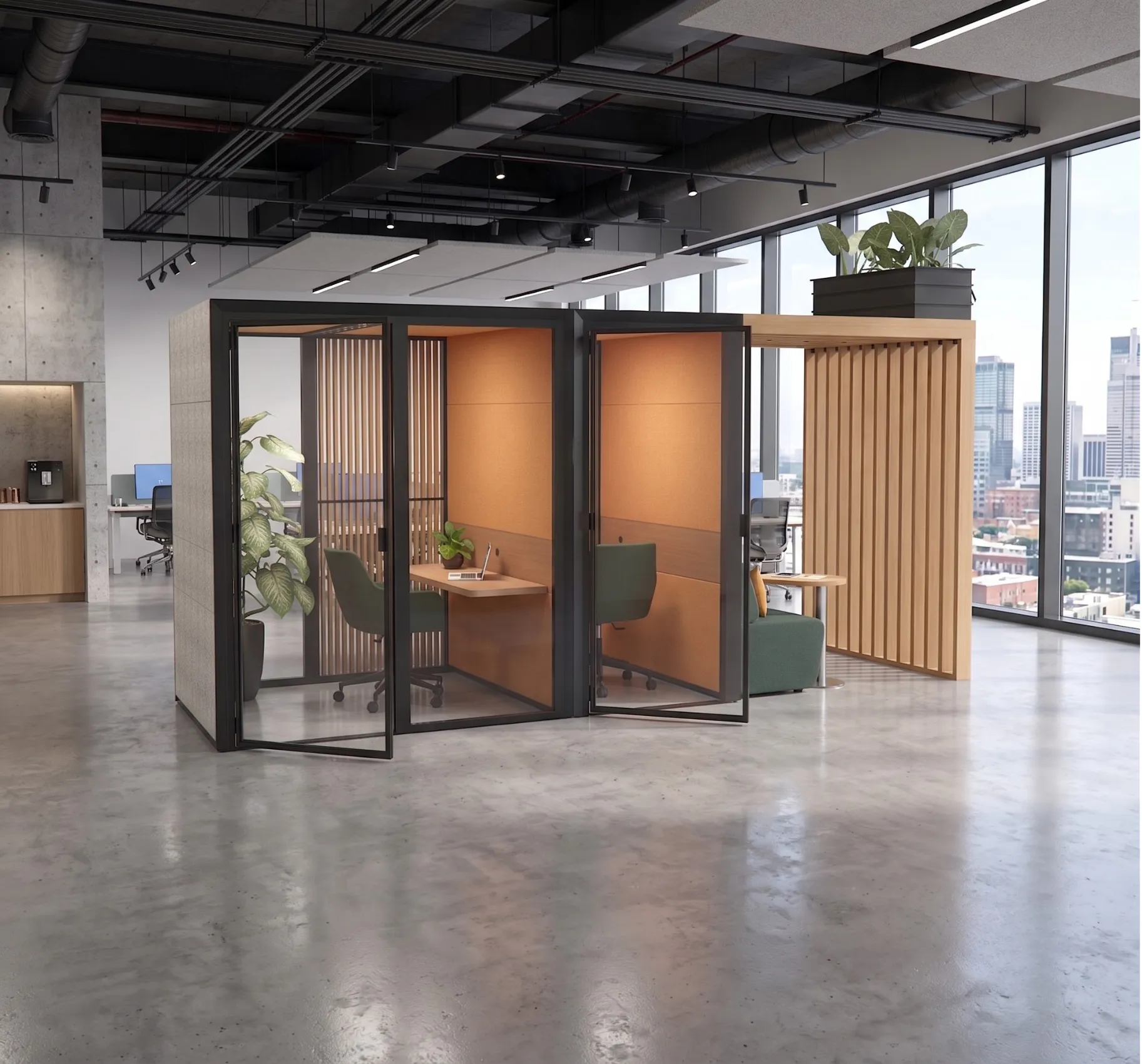
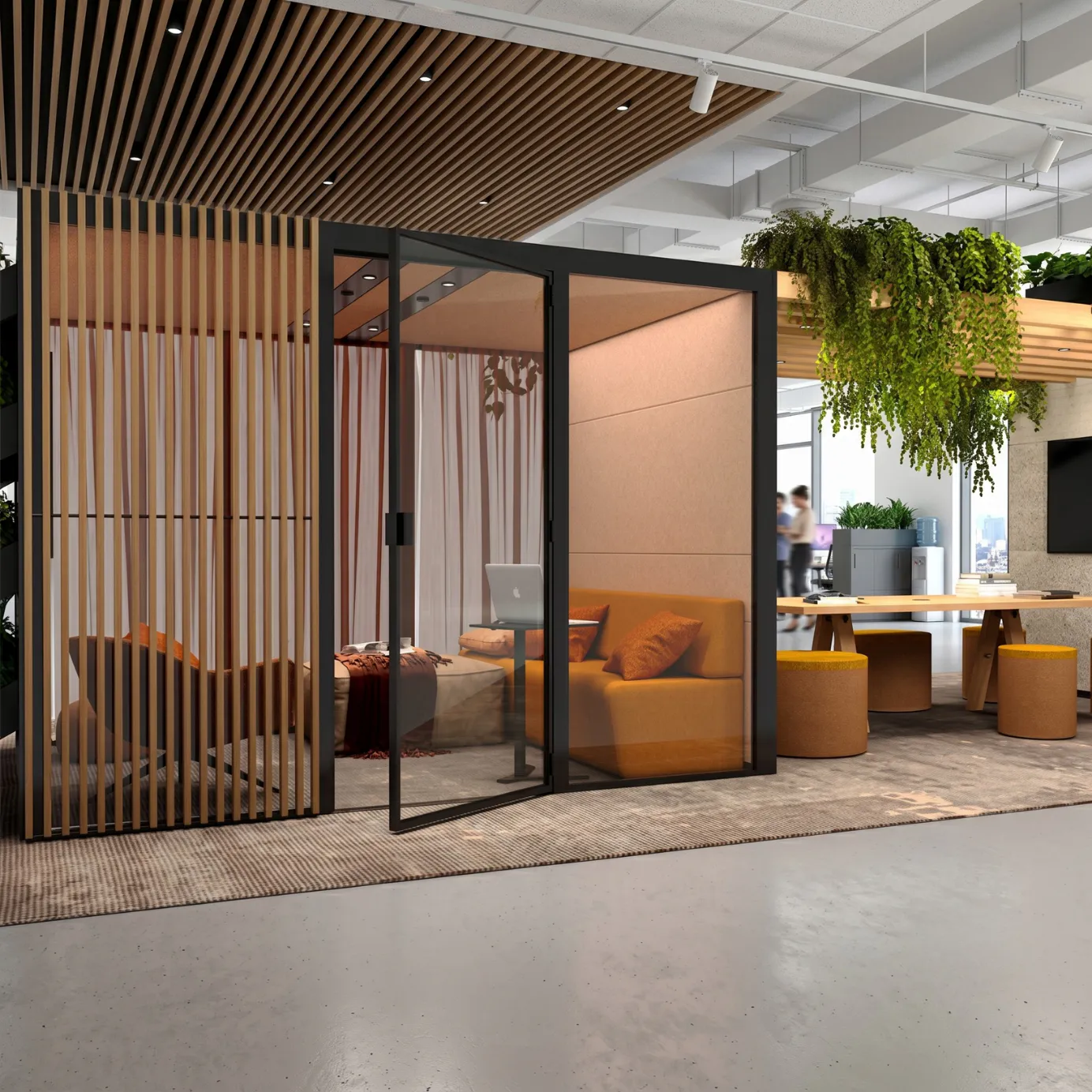
What Is Modular Office Furniture?
Modular office furniture is a workspace system built from interchangeable parts, including desks, panels, storage units, and enclosed pods, that connect, separate, and rearrange as needs change. Fixed pieces only work in one layout. A traditional desk or a built-out room does one job in one place, and it keeps doing that until someone pays to rip it out. This system differs in kind, not just in style, because the same parts serve more than one arrangement across the years you own them.
The honest test is reconfiguration, not material. Genuinely modular office furniture can be rearranged rather than replaced when the office changes. But pieces that only look sectional fail that test. In fact, some of these systems are not really furniture at all, but room-level enclosures that behave like architecture.
How Modular Office Furniture Works: One Component System, Many Configurations
Modular office furniture works because a small set of interchangeable parts recombines into many layouts. A single component grid yields 56 configurations, with panels, glazing, fronts, and backs that swap or replace individually over time. That number is what makes the word “modular” verifiable rather than decorative.
A damaged or dated panel is a panel swap, not a new unit. Nothing gets thrown away to fix one part. The component families follow the same logic. Workstations and desks, panels and dividers, storage, and enclosed acoustic pods share a common architecture. That shared architecture is why any one part can be updated on its own. Rearranging existing parts instead of buying a fresh set is what earns the modular label. A piece that cannot be rearranged is just fixed furniture wearing that label. This same swap logic drives the cost-effective case for office pods.
Benefits of Modular Office Furniture
The value of a modular fit-out is that the space adapts to the team instead of the team adapting to the space. That plays out in three ways. Each one changes a real cost or a real constraint.
Flexibility and Reconfiguration Without a Refit
A modular system reconfigures without a contractor tearing anything out. The same components rearrange for a new team size or a new use of the room. The pods are demountable, not portable, which is the distinction that matters. They come down and rebuild when the floor plan changes, and the no-floor design leaves no trace on the original surface. Because every pod in the range is modular and reconfigurable over time, a layout change becomes reuse rather than disposal.
Fast Assembly and Easy Relocation
This kind of system goes up fast and moves when you do. Every pod is built on-site in less than a day, and needs no floor prep. A built room cannot claim any of that, since changing it means demolition first. Fixed furniture fights every layout change, but modular parts absorb it.
Space Optimization and Room to Grow
A modular system makes better use of the footprint you already pay for. Components size up or down as headcount shifts, so a startup’s first layout is not a dead end when it doubles. The point is scale without a rebuild. The same system that fits eight people is the one that fits twenty. That is where a workspace stops being something you tear out at every stage.
Modular vs. Traditional Office Furniture
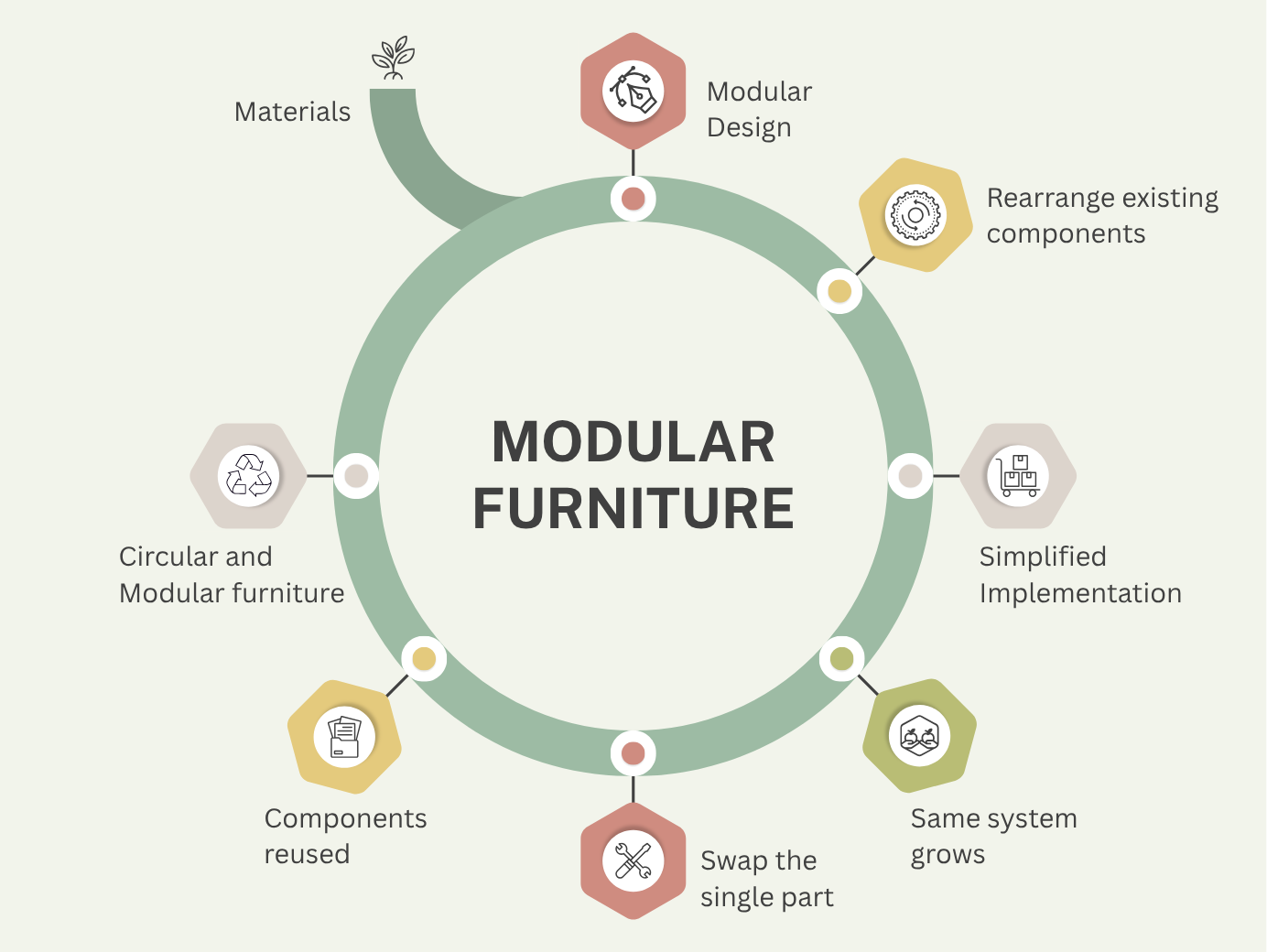
Traditional office furniture is bought once for one layout and discarded when that layout ends. Modular office furniture is bought once and reconfigured across many layouts. That is the entire case in a single sentence. The table below makes the difference concrete. For a deeper cost breakdown, see office pods vs traditional construction.
| Factor | Traditional | Modular office furniture |
|---|---|---|
| Reconfiguration | Fixed; buy new to change | Rearrange existing components |
| Waste at layout change | Rip and replace to landfill | Components reused |
| Install or change time | Demolition and rebuild | Built in less than a day, no floor prep |
| Scalability | Re-buy at each stage | Same system grows |
| Repair | Replace the unit | Swap the single part |
Read down the right-hand column and reconfiguration stops being a feature and starts being the design principle. Every row that costs money or time on the traditional side becomes a swap or a rearrangement on the modular side.
Cost, ROI, and the Long-Term Case for Modular Office Furniture
The real cost of office furniture is not the purchase, it is the replacement. A full build-out or a fixed furniture set carries a strict expiration date. When the layout changes, the whole investment gets written off and hauled out. That is the cost hiding inside anything permanent.
A modular fit-out carries a different logic. Today’s investment is ready for tomorrow’s needs, because the same pieces serve the next layout. You buy the capability once instead of buying the furniture again every few years. Sustainability here is about longevity, not just materials. The greenest, cheapest piece is the one you never have to replace. Decide where to buy on that test rather than on the sticker. For teams weighing the return, our guide to maximizing ROI on office pods runs the numbers.
Product Categories: Desks, Workstations, Storage, Panels, and Acoustic Pods
A modular fit-out spans a few core categories, and each is chosen by the job it does. Desks and workstations handle individual and shared focus work. They give a team its surfaces without committing the floor to one arrangement. Storage units and partitions define zones and shape sightlines. The same panel logic covers walls and room dividers. A space can be split, opened, or re-split without construction. For teams that still think in enclosures, cubicles built this way come apart and rebuild instead of getting scrapped.
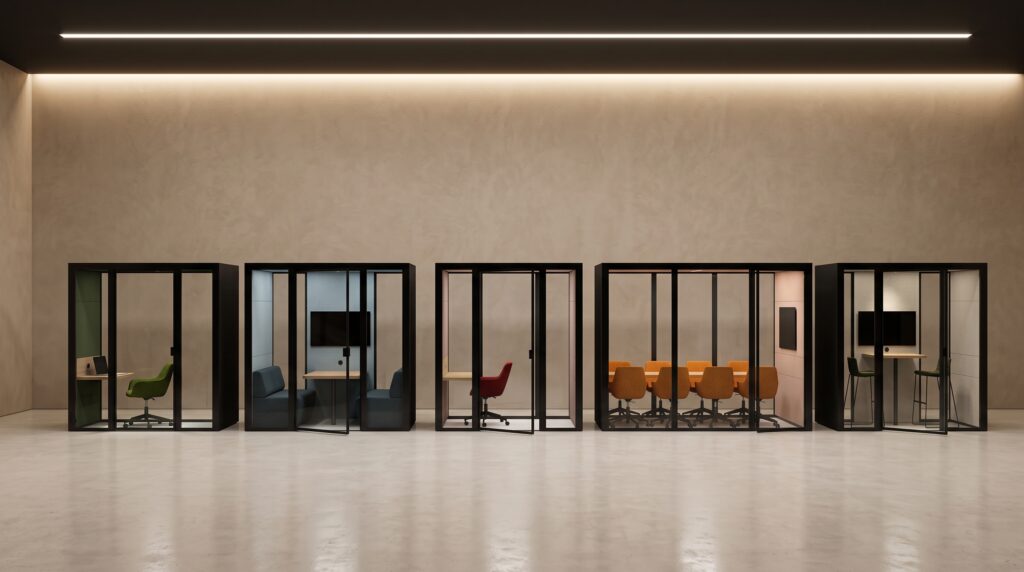
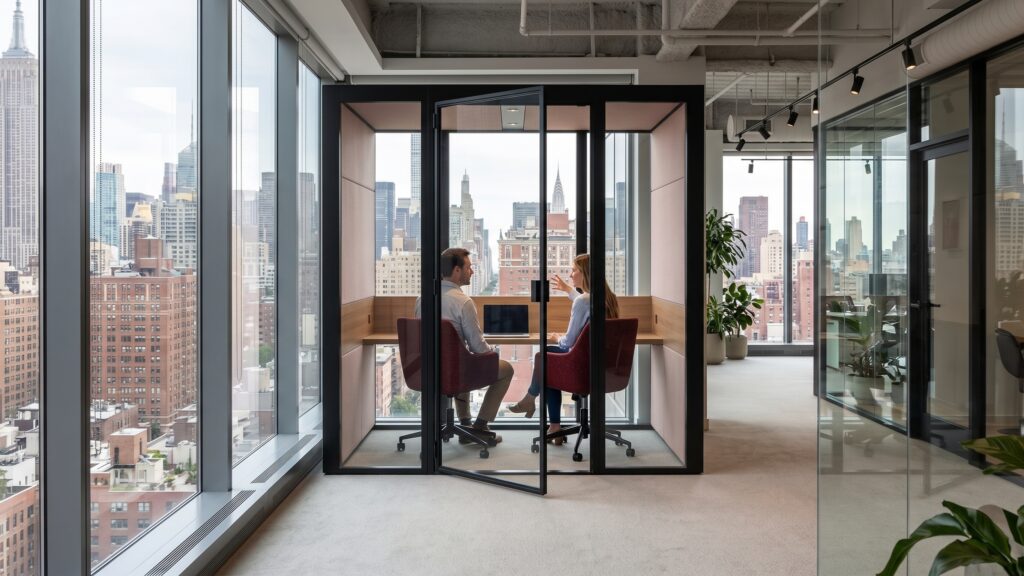
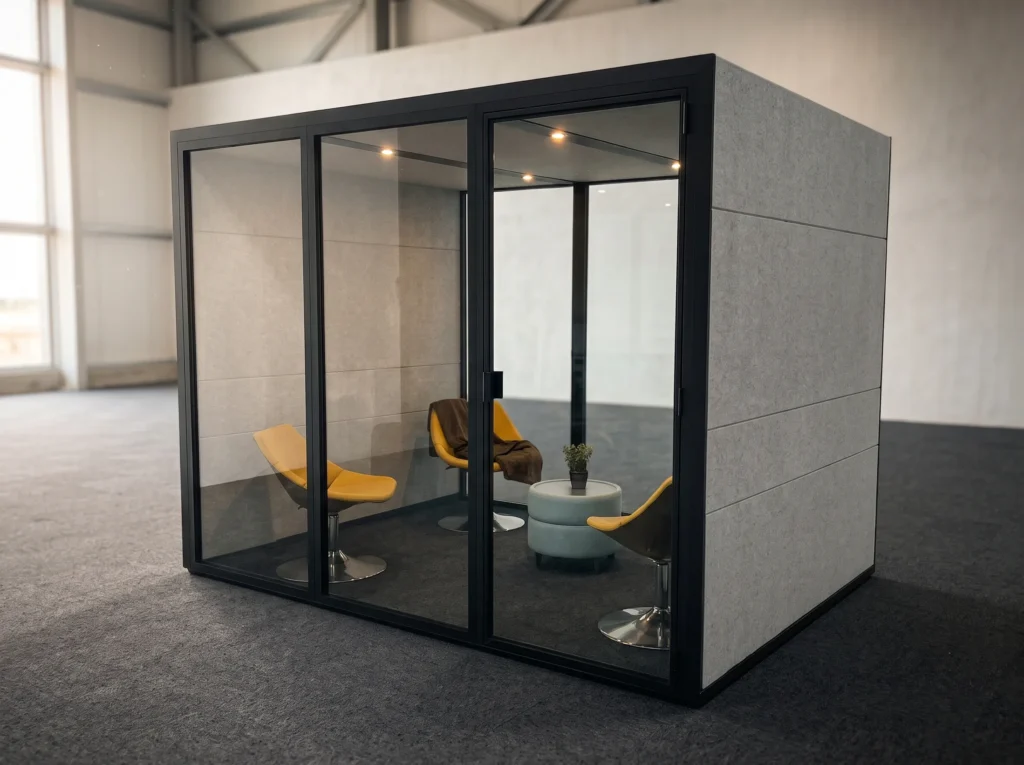
Enclosed acoustic pods are the category we lead with, and size maps directly to use case. Single-user pods handle focused work and private calls. Larger connected pods host team meetings up to around a dozen people, with a conference table inside the bigger pods for exactly that. Every pod is modular and reconfigurable over time, so the range scales with the room rather than boxing it in. Customization runs deeper than a color swatch. A wide range of fabric options covers interior customization, which matters when the pod has to fit an existing space rather than fight it. Beyond the office, the same pod platform adapts to schools and higher education settings.
Space Optimization: When Modular Office Furniture Becomes Architecture
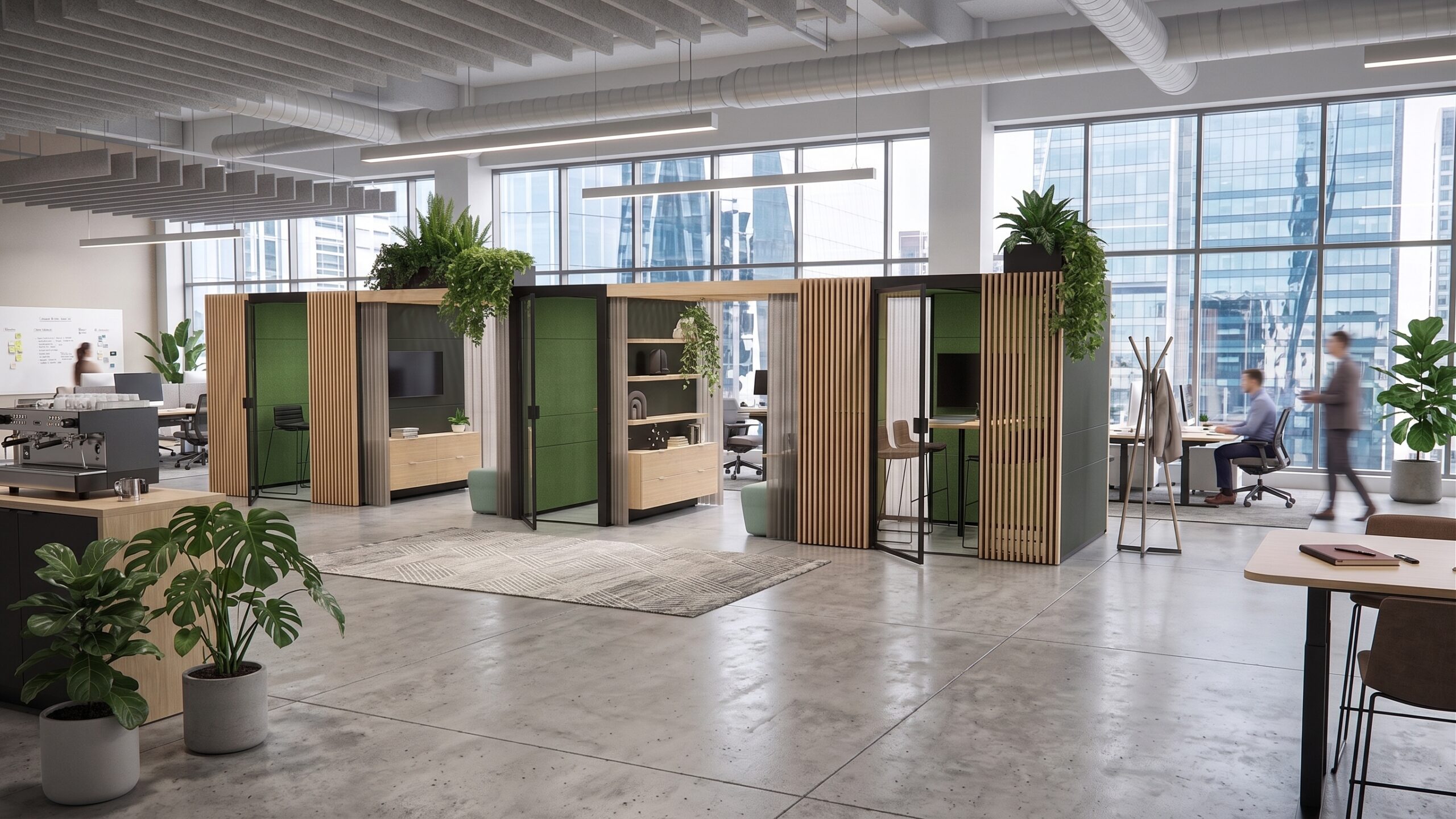
Connected in series, a modular system stops being separate pieces and starts defining space like architecture, without permanent construction. Joined pods create defined zones and coherent spatial structure while staying fully reversible. The floor then reads as designed rather than assembled. The defensible claim underneath is specific. Connected in series, acoustic and ventilation performance holds across every unit, so joining pods does not dilute what each one does.
Acoustic Performance: Turning Open-Plan Noise Into Focused Space
The hardest problem an open plan hands a modular fit-out is noise. Only an enclosed, sound-absorbing space actually solves it. Private calls and focused work need real acoustic separation, not a partition that changes what you see without changing what you hear. Productivity and client experience depend on that separation first, because a dropped call or a distracted proposal costs more than the pod does.
The credential is plain. Class A sound-absorbing pods shut out at least 30 dB of ambient noise, which creates on-demand privacy the moment someone steps inside. This is where enclosed pods pull away from screens that only redraw sightlines. A place to take a call or think is not an amenity you add when budget allows. It is part of what makes an open floor work at all. Treat quiet as infrastructure and the open plan becomes usable. Treat it as a perk and it stays the reason people work from home.
Sustainability and Reduced Waste
The most sustainable furniture is the furniture you do not throw away. Modular office furniture keeps material in use across layout changes instead of landfilling it. Quality comes first here, because a durable, high-performing piece is the precondition for the eco claim, not a trade-off against it. The circular numbers back that up. Ecolution Design pods are made from up to 91% recycled content going in. They are also 99% recyclable at end of life. The pods are designed for disassembly, so components separate and recover individually. That is urban mining rather than demolition, and it works because the pieces were built to come apart. This is the same thinking behind circular economy office pods.
The supply chain carries its own argument, and it leads with logic before the flag. Ecolution Design furniture is designed and manufactured in Grand Rapids, MI, with locally sourced materials and no overseas production. That local sourcing means a shorter supply chain, lower embodied carbon, and faster lead times and repairs. Furniture made an ocean away spends its footprint before it arrives. Built close to where it ships, the system answers the next layout change faster and cleaner. That is a sustainability claim as much as a service one.
Who Should Buy Modular Office Furniture
Modular office furniture fits any team whose space will not look the same in three years. Startups and growing companies benefit most, because they cannot commit to a fixed layout without betting against their own growth. Commercial tenants need the reversibility, since a no-trace fit-out means nothing to rip out at lease-end. Hybrid and facilities teams get the third case. They balance focus and collaboration on anchor days when the floor is full and quiet runs out fast. The one thing all three share is a moving target. And when a room sits empty between uses, the same pods make repurposing unused spaces straightforward.
Accessibility is designed in from the start rather than retrofitted. The no-floor design sits flush with the existing floor and clears a wheelchair with no threshold. As a result, ADA-compliant access is the default across the range, not a special variant you order separately. That is simply better design, and it is one of the quieter reasons buyers who compare systems tend to land on the ones built this way.
Why Ecolution Design Modular Office Furniture
Ecolution Design pods sit in a third category, neither furniture nor construction. They deliver room-level performance without permanent change. Ecolution Design would rather show proof than list values, so here is what holds up.
Built to Adapt
Our range is modular end to end, so a layout change is a rearrangement, not a purchase. In our experience, the swap logic is what customers underestimate at first. A dated or damaged part comes out on its own, the rest stays, and the office keeps its investment instead of restarting it. That is the system doing the one thing the name promises.
Class A Sound Control
Our pods carry a Class A sound-absorbing rating that shuts out at least 30 dB. That is what makes on-demand privacy real rather than implied. A quiet space you can count on is the difference between an open plan that works and one people avoid, and this is the credential that backs it.
Made and Sourced in the USA
We design and build in Grand Rapids, MI, with local materials. That keeps the supply chain short and lead times and repairs fast. The domestic sourcing is a service argument before it is a pride one. When a part needs replacing or a pod needs reconfiguring, closer is quicker, and that speed is part of what you buy.
Frequently Asked Questions About Modular Office Furniture
What is modular office furniture?
Modular office furniture is a workspace system built from interchangeable parts, including desks, panels, storage, and enclosed pods, that connect and rearrange as needs change. Unlike a fixed desk or a built room that only works in one layout, the same components serve many arrangements over time, so you reconfigure instead of replacing.
Is modular office furniture worth it?
Yes, because the real cost of office furniture is replacement, and a modular system is bought once and reused across layouts instead of rebought at every change. A fixed fit-out gets written off when the floor plan shifts, while modular components rearrange for the next layout, so the value grows the longer the space keeps changing.
Modular vs. traditional office furniture: which lasts longer?
Modular systems last longer in practical terms, because a single worn or dated part is a swap rather than a full replacement. Traditional furniture is discarded as a unit the moment one part fails or the layout ends, while modular systems built for disassembly keep the rest of the piece in service and recover components at end of life.
Can modular office furniture be reconfigured after it's installed?
Yes, reconfiguration after installation is the point of the system. The components are demountable, so they come down and rebuild when the floor plan changes, and the no-floor design leaves no trace on the original surface. One component grid yields dozens of configurations, which means the same parts you install today serve a different arrangement later.
Modular Office Furniture and the Case Against Permanence
Permanence is the risk. The one thing you can predict about any office is that the layout will change. The furniture that survives that change is the furniture designed to move. A fixed fit-out bets against your own future, and it loses that bet on a schedule you cannot see when you sign for it.
The office is what should adapt, not the team squeezed into a shape someone chose years ago. Modular office furniture is that idea in a form you can actually buy and rearrange. The workspace then bends with the next change instead of breaking on it. Stop paying to rip out and replace a fit-out every time the team moves. Start with a system that rearranges into the next layout instead of landing in a landfill, and our team would be glad to help you plan it.