Library With Meeting Room: Built Room or Acoustic Pod?
It is 9:40 on a weekday, and the one glassed quiet room is already booked until three. A patron arrives needing silence to study. A table away, a job-seeker opens a laptop for a video interview, and the desk has no good answer for either of them. Planning a library with meeting room capability means the floor plan has to serve two rooms at once. Here it cannot do both. The reader is not too demanding and the job-seeker is not rude. The building is what underperforms.
In this post, we'll take a look at:
Quiet is not a perk a library grants when it has the space to spare. Quiet study space and room for group work are both core function now. The honest question for anyone planning a library with meeting room capability is which structure delivers both. A fixed, built meeting room suits a branch that needs one permanent, single-purpose room in a location it will never change. A modular acoustic pod suits a branch planning around shifting demand, where study, group projects, and remote calls all rise and fall week to week.
How can a library have a meeting room without sacrificing its quiet zones?
A library keeps its quiet zones by containing noise at the source. Give group work and remote calls a self-contained acoustic room, and voices stop spreading across the open reading tables. You protect the silence not by asking people to whisper but by giving the loud activity somewhere to happen.
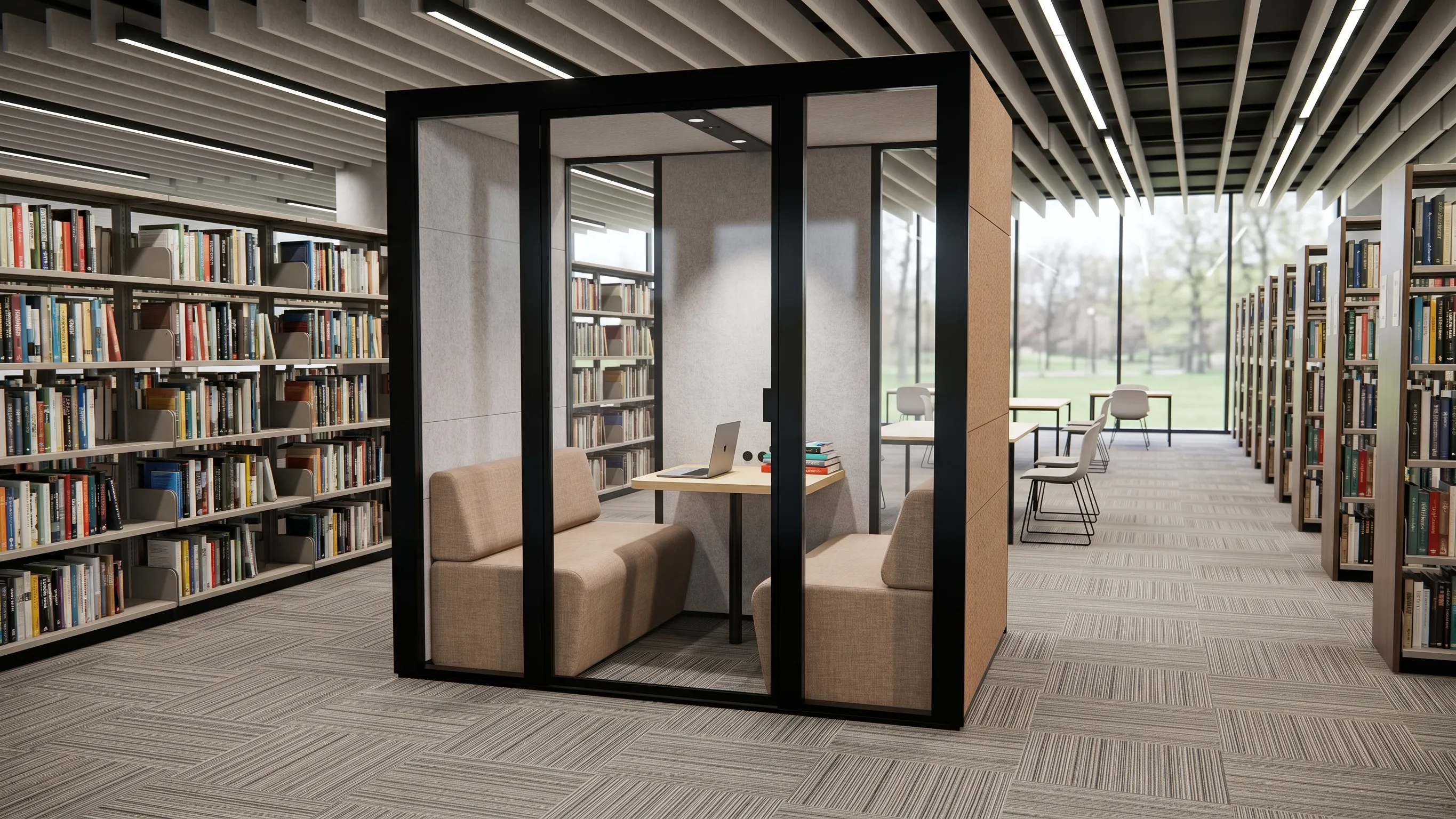
The branch that only lent books and enforced hush is gone. A library now functions as a community hub for remote work, tutoring pairs, group study, and back-to-back video calls. That dual mandate is the real design problem. The false choice most buildings accept is stark: either a single glass room booked out by mid-morning, or voices carrying across the floor all day. A modular acoustic office pod is a third category, neither furniture nor construction. It delivers a built room’s acoustic performance without permanent architectural change. The pod owns the focused, heads-down, private mode. The open floor stays collaborative. Neither has to compete for the other’s territory.
What is a built meeting room best for a library?
A built drywall meeting room is best for a library that needs one permanent, single-purpose room in a fixed location. It fits when a branch can accept weeks of construction and a closed-off public area, and when the room’s size and use hold steady for the long term.
You design a built room once, and an inspector checks it for accessibility case by case, so its privacy is only as good as its door and its seals. Changing it later means tearing it out. None of that is a flaw when permanence is genuinely the goal. If a branch knows it needs a single conference room in one spot for the next fifteen years, drywall is the right tool for that job.
What is a modular acoustic pod best for a library?
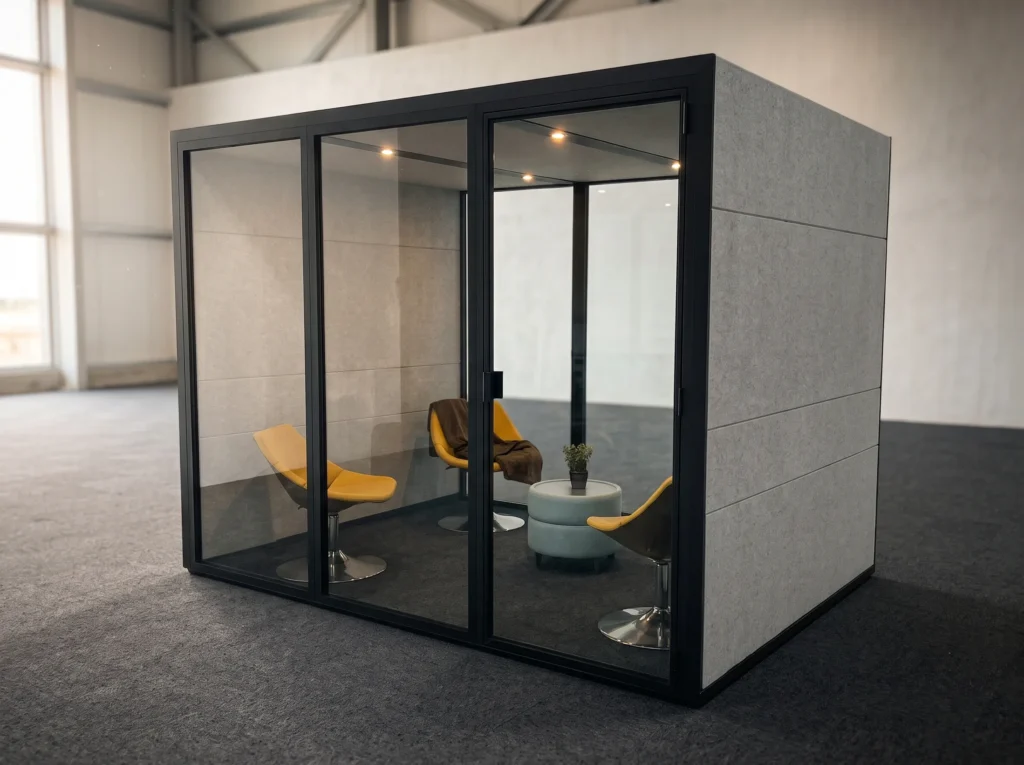
A modular acoustic pod is best for a library that needs meeting and quiet capability on demand and expects its needs to change. The pod drops into the existing floor, is built on-site in less than a day, connects to a standard power outlet, and comes apart again when the layout shifts.
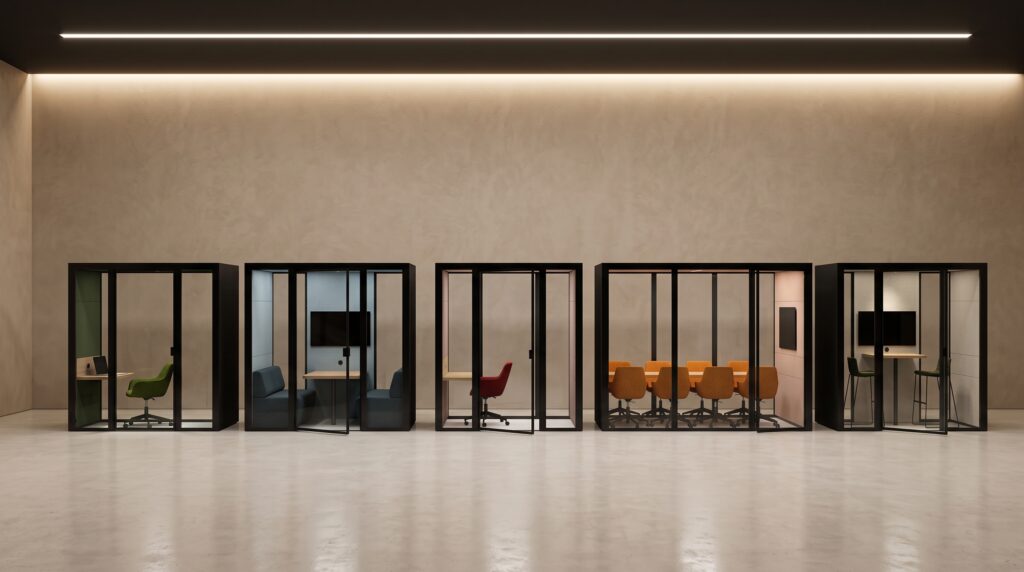
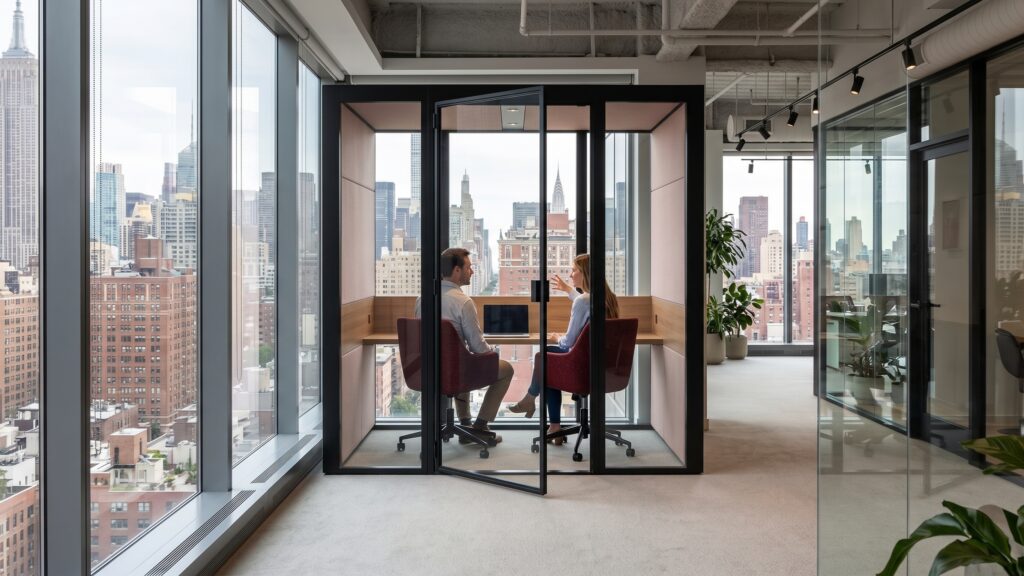
On-demand privacy is the sharpest advantage here, and it beats a scheduled meeting room outright. The single glassed quiet room is a resource patrons queue for, and it is gone by mid-morning. A pod is simply there at the moment of need, whether that is a video interview, a tutoring pair, or a small board discussion. A study pod for campuses and libraries can start as a private meeting room for one. It then scales up to a configuration seating around a dozen. The same product line covers a solo student, a study group, and a small meeting. That is what the front desk cannot hand a patron on its own: a small meeting room that was not there an hour ago and does not need to be booked days ahead.
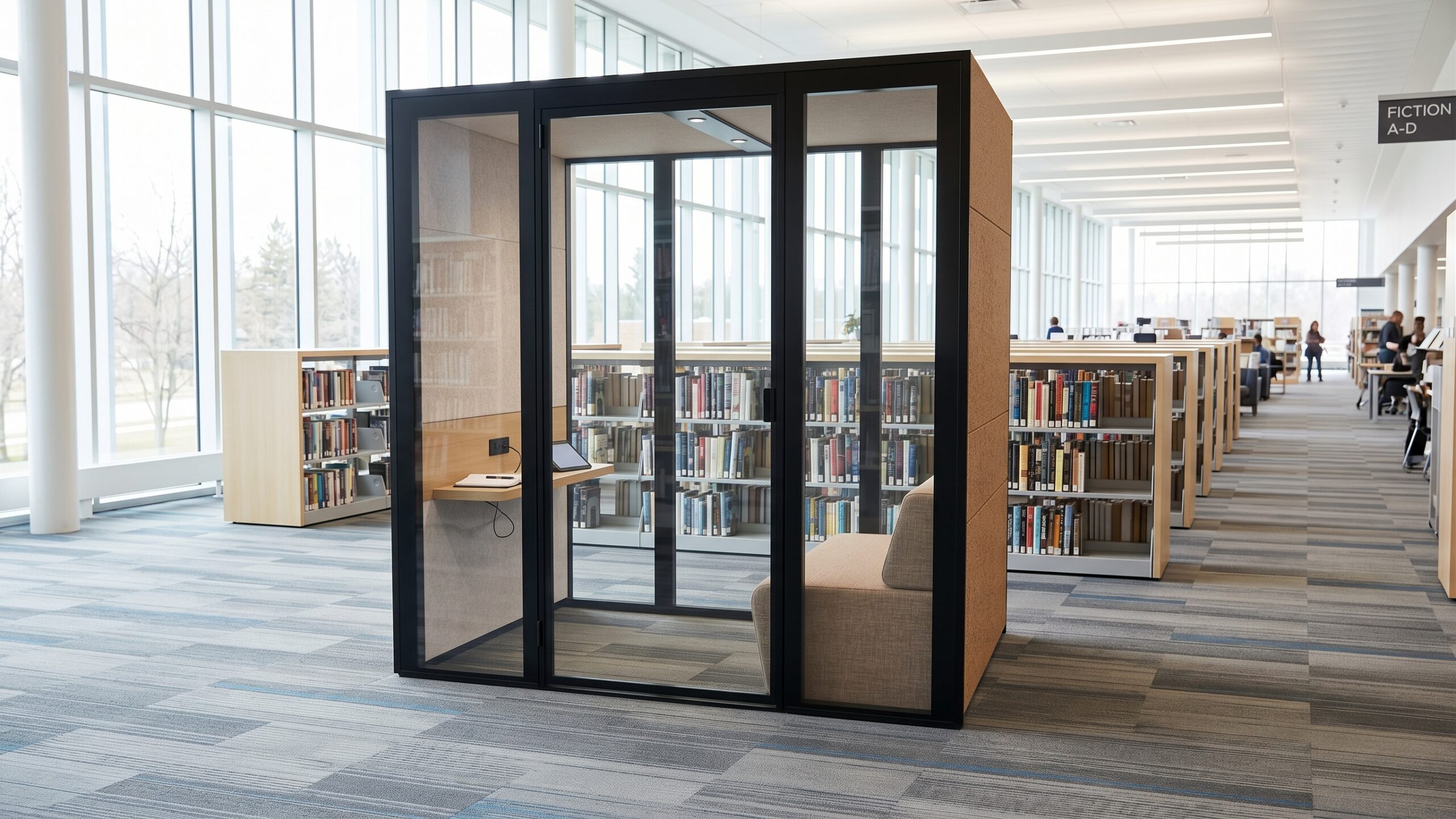
Built meeting room vs modular acoustic pod: a side-by-side comparison for libraries
The two options diverge most on speed, reversibility, and how privacy holds up in a shared reading room. Everything else follows from those three. The table below sets the decision axes against both options so the trade-offs are visible at a glance.
| Decision axis | Built meeting room | Modular acoustic pod |
|---|---|---|
| Speed and disruption | Weeks of construction with the space closed off | Built on-site in less than a day, connects to a standard power outlet, no floor prep |
| Reversibility and permanence | Permanent and single-purpose, torn out to change | Demountable and reconfigurable, leaves no trace, dozens of configurations from one component grid |
| Acoustic isolation | Privacy only as good as its door and seals | Class A, shuts out at least 30 dB as a complete enclosure |
| Headcount and size | Sized once and fixed | Single-user up to a configuration seating around a dozen, with acoustic and ventilation performance maintained across connected pods |
| Accessibility | Designed and inspected for compliance case by case | Flush, no-threshold entry, ADA compliant with an ADA-wide doorway across the range |
| Sustainability and lifecycle | Materials largely landfill at end of life | Up to 91% recycled content, up to 99% recyclable, designed for disassembly, manufactured in Grand Rapids, MI |
A modular acoustic pod is built on-site in less than a day, while a drywall meeting room closes off the space for weeks. A pod comes apart and rebuilds when the floor plan changes, while a built room needs demolition to become anything else. This is a permanent decision about the library’s own floor. The pod is the only one of the two that lets a branch change its mind.
When is building a fixed meeting room the wrong choice for a library?
Building a fixed meeting room is the wrong choice when a library’s use is still shifting, when it cannot close a public space for weeks, or when it may reconfigure or relocate the room later. It is also the wrong choice in a leased or heritage building where permanent change is off the table.
The built room still genuinely wins in two cases. The first is a truly permanent, single-purpose room that will never move. The second is a site with no route to bring panels in for a pod at all. Where those conditions do not hold, the reversibility argument decides it. A demountable pod reconfigures or comes out without permanent change. That is exactly what a library facing uncertain future demand should want. The most affordable path over ten years is rarely the one a crew has to demolish to answer a new question. A branch may want to expand, shrink, or move a meeting space as its neighbourhood changes. That is a reason to keep the option open rather than pour it in place. Configurations that can evolve protect the investment. A fixed room bets that today’s floor plan will still fit in a decade.
How do acoustic pods let calls and group work coexist with silent reading?
A pod contains sound at its source, so a video call inside it does not carry to the reading tables outside. That containment is the whole mechanism, and it is what makes the two activities compatible in the same room.
A Class A rating shuts out at least 30 dB of ambient noise. A Zoom call inside the pod stays inside the pod, and the silent zone stays silent. Air refreshes continuously inside the enclosure, so a long meeting or a two-hour study session stays comfortable rather than stuffy. A university recently installed Ecolution Design pods for on-demand privacy in its busiest campus buildings. That is one of many pod deployments in higher education. That deployment grounds the argument in real use rather than a promise. Where open flow and private need collide, the pod is the room that appears exactly where the collision happens.
How does a library pod flex as the space and its use change?
A library pod flexes because it stays demountable and reconfigurable, drawing on one interchangeable component system. A branch can change the space as demand shifts rather than living with a room that stays sized once and stuck that way.
Dozens of configurations come from a single component grid, and panels, glazing, fronts, and backs swap over time. A damaged panel is a panel swap, not a new pod. A branch can start with one quiet booth and grow a connected run of study and meeting zones as budget allows. When Ecolution Design pods are connected in series, the acoustic and ventilation performance holds fully across the units. Modular office furniture that reconfigures on this principle means the meeting room layout is never a one-time decision.
Why Ecolution Design for library meeting spaces?
Our answer for a library is a demountable acoustic room that performs like built space without the construction. In our experience that is what a branch actually needs when it cannot pin down what next year looks like.
Our pods carry a Class A rating and shut out at least 30 dB, and we manufacture them from up to 91% recycled materials, with up to 99% recyclable content at end of life. Because we design them for disassembly, components recover individually rather than heading to landfill, in line with the EPA’s sustainable materials management approach. We design and manufacture in Grand Rapids, MI with locally sourced materials. That shortens the supply chain and the lead times, so a pod can land inside a budget cycle instead of chasing it. The flush, no-threshold entry is ADA compliant and consistent across the range.
Frequently Asked Questions
Can a library add a meeting room without construction?
Yes. A modular acoustic pod drops into the existing floor, is built on-site in less than a day, so the branch stays open and nothing gets closed off for weeks.
Are acoustic pods ADA compliant for public libraries?
Yes. The flush, no-threshold design sits level with the existing floor and pairs with an ADA-wide doorway, and that accessibility runs across the range rather than being a single special variant.
Will a video call inside a library pod disturb people reading nearby?
No. A Class A rating shuts out at least 30 dB, so a call inside the pod does not carry to the reading tables, and the quiet zone stays quiet.
How many people can a library acoustic pod seat?
Anywhere from a single user up to a configuration seating around a dozen. The same product line covers a solo study booth, a tutoring pair, and a small group meeting, so one supplier answers every headcount. A library with meeting room capability designs quiet and collaboration in on demand, rather than rationing them at the front desk while patrons compete. Focus and flexibility stop being a choice once the private, heads-down activity has a room of its own and the open floor is free to stay collaborative. Stop asking one glass room to be a study hall and a call booth on the same morning. Start designing quiet in as infrastructure, so the branch answers the reader and the job-seeker at the same time. Specify Ecolution Design™ for your next library project.