Office Privacy Booth: A Buyer’s Guide vs. Building a Room
It is 9:40 and every enclosed room on the floor is already booked through lunch. A sales rep three desks over runs a client call on speaker because there is nowhere else to take it, and the two people trying to think through a proposal hear every word. This is the exact gap an office privacy booth fills. The rep takes the meeting anyway, half-apologizing about the background noise, and the proposal work slides to the evening at home. That is not a discipline problem. The problem is the room, not the person. When there is nowhere quiet to take a call or think, people improvise, and the work suffers for it.
In this post, we'll take a look at:
An office privacy booth is a freestanding, enclosed workspace that gives on-demand privacy for calls and focused work without any construction. The booth carries a Class A acoustic rating that shuts out at least 30 dB of ambient noise, so a conversation inside stays inside.
This guide covers what a privacy booth actually is, what makes one genuinely quiet, whether it beats building a room, how sustainable it is, whether it is accessible, and what to check before you buy.
What is an office privacy booth?
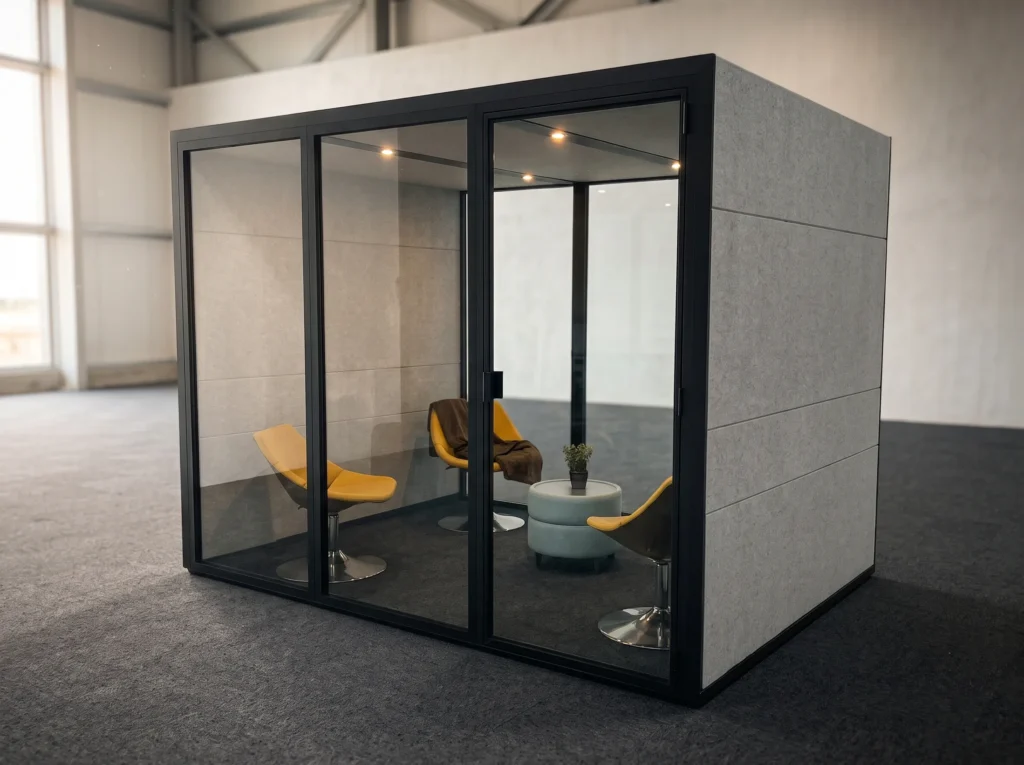
An office privacy booth is a freestanding enclosed pod that delivers room-level acoustics, ventilation, and power without any permanent architectural change. You place the booth where you need the privacy. When the floor plan changes, you take the booth down and rebuild it in a new spot.
The useful way to think about a privacy booth is as a third category. A booth is neither furniture nor construction. That distinction matters because the usual choice between furniture and construction is a false one. Furniture cannot give you speech privacy. A screen or an acoustic panel softens sound and takes the edge off a hard room. A panel never contains a conversation, so the person at the next desk still hears the client’s name and the number on the table. Construction gives you a real room. A built room needs walls, a permit, and weeks of downtime. It also locks the space into a floor plan you may not want in two years.
A privacy booth sits in that gap. You never have to choose between performance and flexibility. When people say “speech privacy,” they mean one thing: you can tell a conversation is happening inside, but you cannot make out the words. An office privacy booth delivers exactly that outcome.
What can you actually use one for?
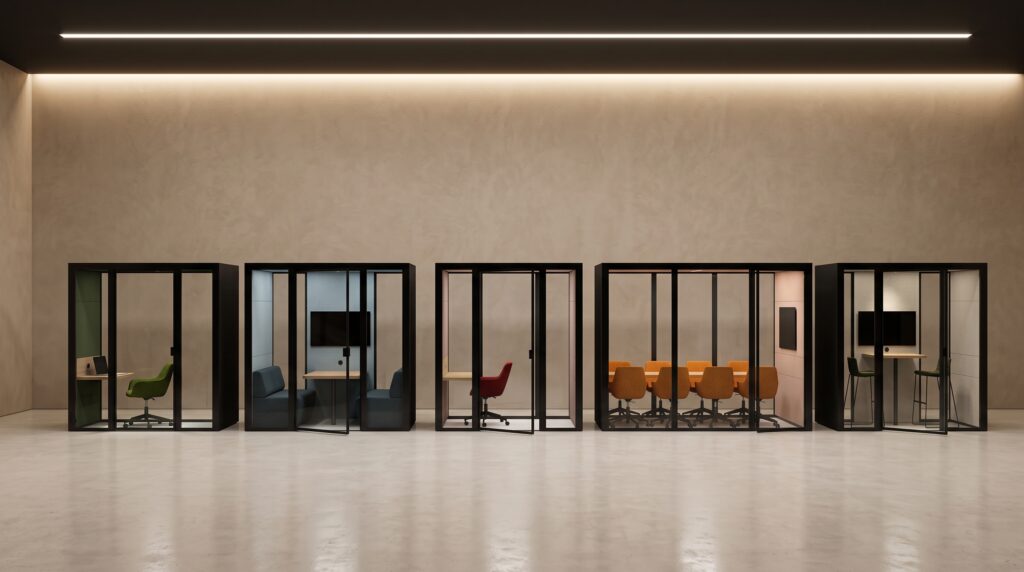
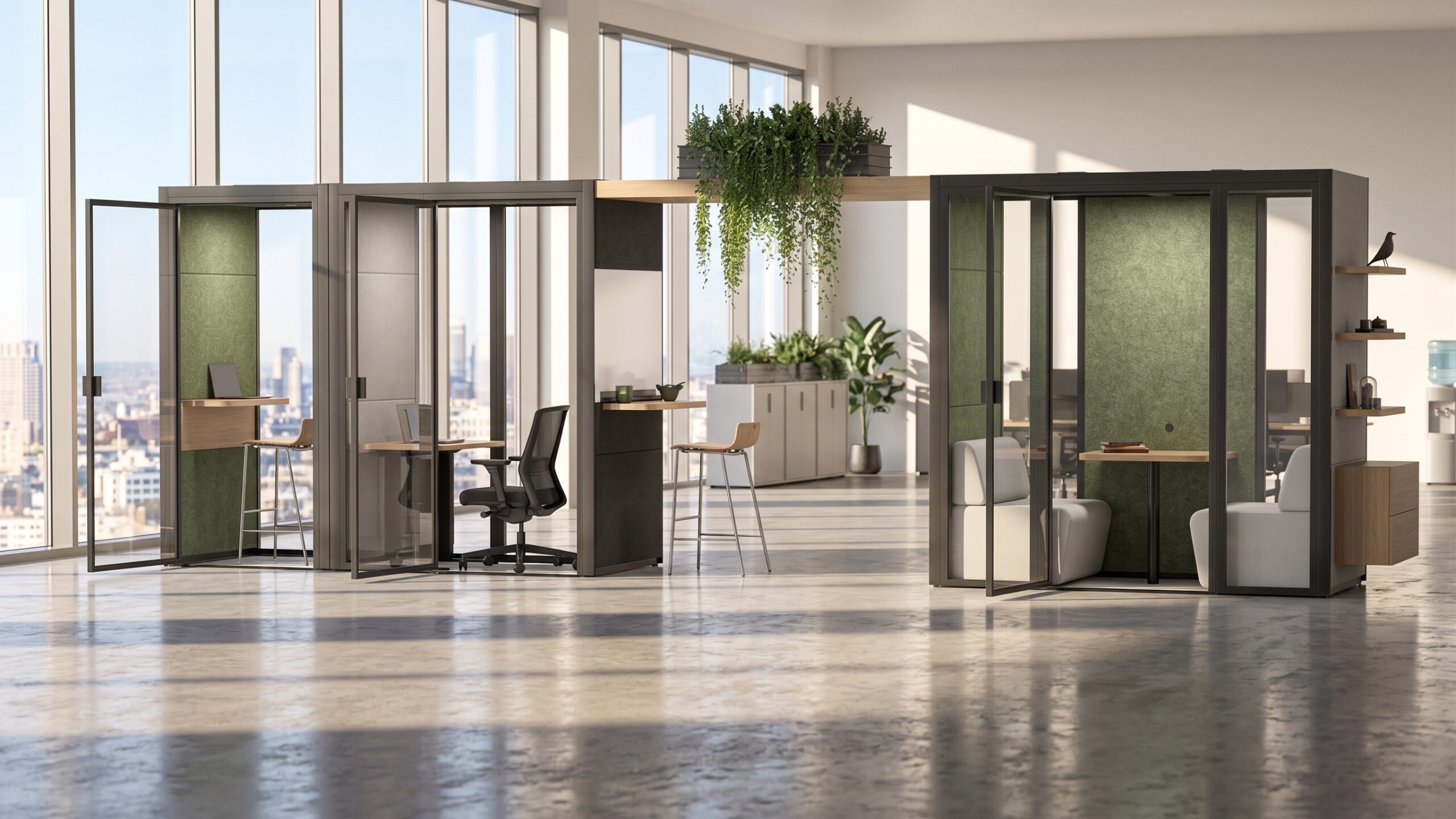
An office privacy booth covers private calls, heads-down focus work, one-on-one conversations, and small-group collaboration. The range runs from a single-user booth up to a Connected configuration that seats a full team, so the same product family answers a phone call and a working session.
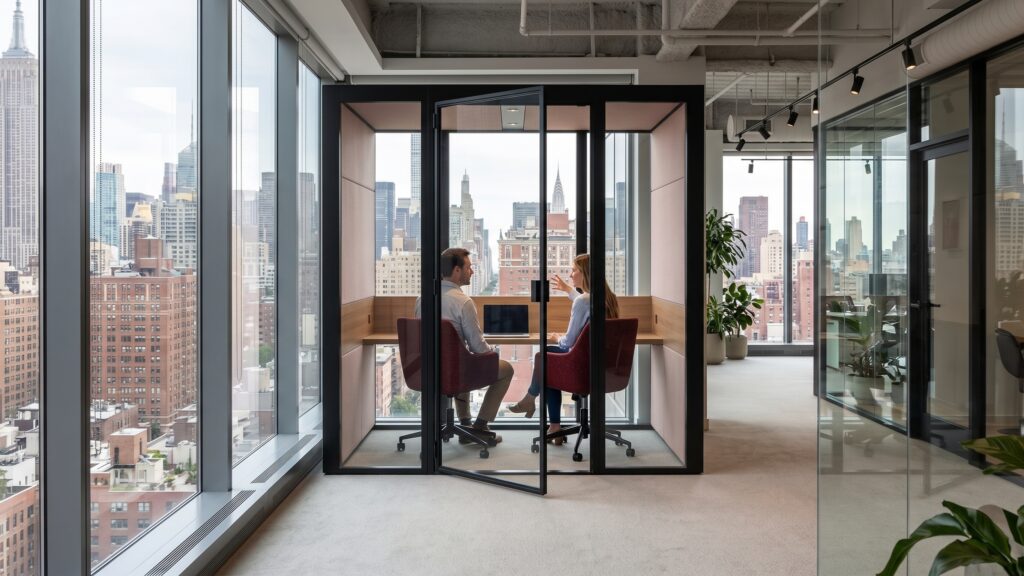
Match the booth to the job, not to a headcount guess. A private call or a block of deep work needs a single-user booth. You step into and out of a single-user booth as the day demands. A one-on-one review, a sensitive HR conversation, or a two-person working session wants a two-to-four person booth. Both people can sit and talk without the whole floor listening in. Recurring small-group work or a compact meeting maps to a larger Connected configuration. A Connected configuration joins several pods together to hold a real discussion.
The value in every one of these cases is on-demand privacy. A privacy booth appears where and when the work needs it, rather than forcing someone to book a room three days out. That logic reaches well beyond the corporate office. Healthcare, libraries, and campus buildings all face the same shortage of quiet, and the same pods adapt to medical office interiors and study spaces on campus.
What makes one genuinely quiet?
A genuinely quiet office privacy booth is rated Class A and shuts out at least 30 dB of ambient noise. A Class A booth keeps a call inside from carrying to the desks outside. A Class A booth also keeps the floor’s noise from reaching the person on the call. The rating is the credential. The two-way containment is the point. Ecolution Design tests every pod as a complete enclosure under ISO 23351-1, the only ISO standard designed for pods.
Speech privacy is the real goal, and speech privacy works in both directions. Someone outside can tell a conversation is happening but cannot make out the words. The person inside is not fighting the open plan to hear their own client. A room can be quieter without being private. A booth worth buying delivers both.
Be skeptical of the word “soundproof” on its own. “Soundproof” is a marketing word with no number behind it. Office soundproofing claims mean nothing until a supplier attaches an acoustic class to them. Read the acoustic class first. If a supplier leads with “soundproof” and cannot name a rating, that is your answer. Real office noise reduction comes from a tested enclosure. The suppliers that deliver it will name the class without being asked. For the full picture on how enclosure testing works, see our guide to soundproof office pods.
Is it a real alternative to building a private room?
Yes. For most privacy needs an office privacy booth is the better call. A booth delivers room-level acoustics and ventilation without betting the outcome on a floor plan that is going to change. A built room is a wager that the layout is final, and most layouts are not.
Buyers underweight the real risk in a built private room. The risk is not the invoice. The risk is the permanence. You pay to fix privacy to a location, and location is the one thing an office reliably outgrows. A booth that reconfigures survives the reshuffle that would strand a wall. An office privacy booth installs in less than a day, whereas a built room takes weeks of construction. The two options compare directly across six factors.
| Office privacy booth | Building a private room | |
|---|---|---|
| Speech privacy | Class A, tested as a complete enclosure | Depends entirely on how the walls, door, and seams were built |
| Install and disruption | Built on-site in less than a day | Weeks of work, plus a permit and construction downtime |
| Reversibility | Demountable and reconfigurable, leaves no floor trace | Permanent; only demolition undoes it |
| Accessibility | ADA compliant by default, no-floor design | You have to design and build in access from scratch |
| Scaling | Pods connect in series with performance holding | Each new room is another round of construction |
| End of life | Up to 91% recycled, 99% recyclable | A demolished room is largely landfill |
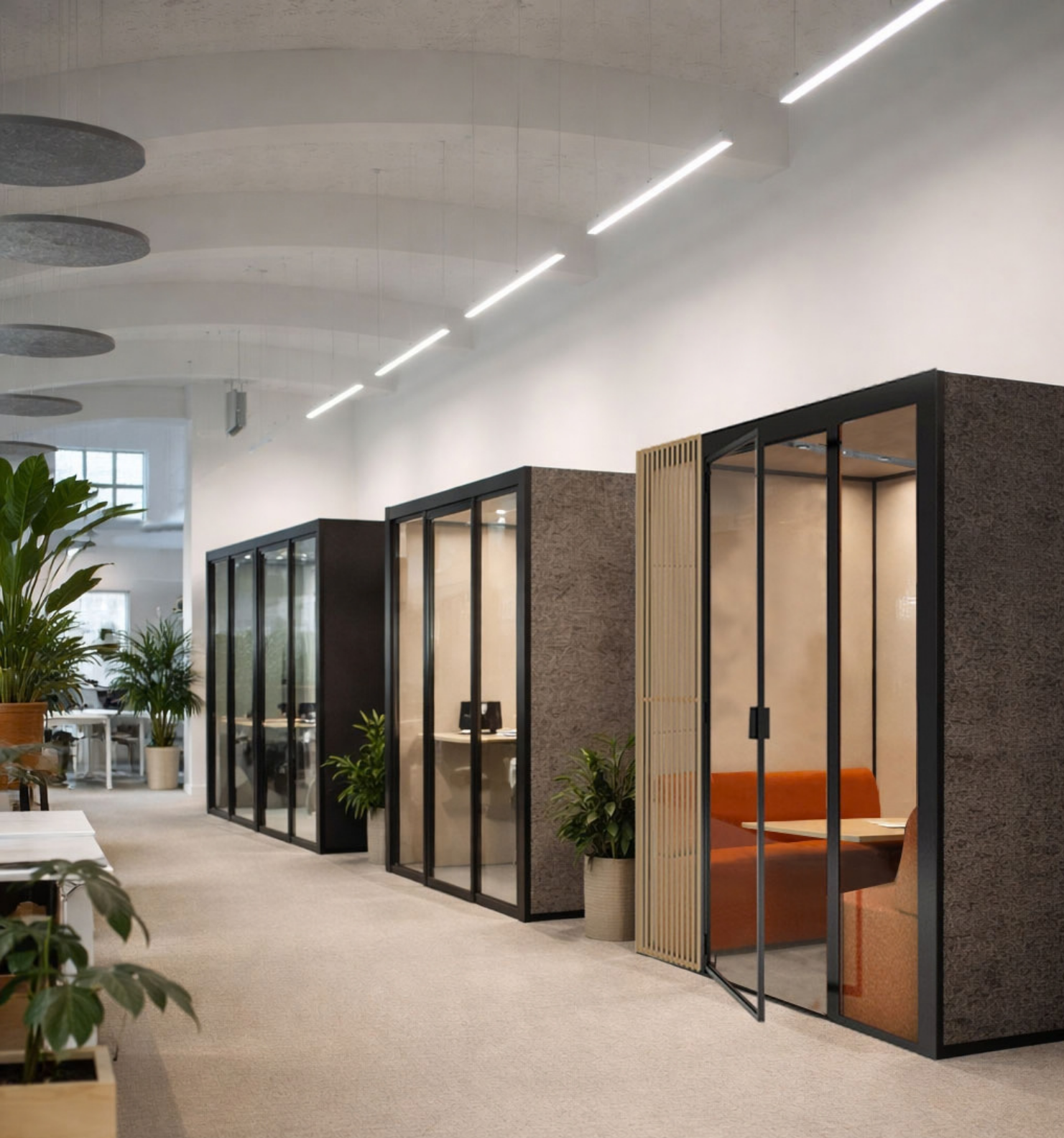
The scaling line is not theoretical. Pods connect in series, and the acoustic and ventilation performance holds fully across the joined units. Fresh air keeps circulating and power routes seamlessly between units, with no permanent structural change. A booth adapts where a built room commits. That is the case for privacy at scale.
When a booth is the wrong choice
An office privacy booth is not the answer when you need a permanent, large enclosed space that will genuinely never change. Examples include a full conference suite for a fixed headcount, a lab or clinical room with specialized build requirements, or a private office one person occupies all day, every day. In those cases, build the room. An office privacy booth wins in three conditions. First, it wins when privacy needs are on-demand. Second, it wins when those needs are distributed across a team. Third, it wins when the need is likely to move as the floor plan evolves. Those three conditions describe most offices most of the time.
How sustainable is one?
A well-made office privacy booth is sustainable on two fronts. High recycled content goes in, and near-total recyclability comes out. A good booth is also designed to reconfigure and disassemble instead of becoming waste. Lead with the build quality, because build quality is what makes the sustainability real rather than a label.
The figures matter. An Ecolution Design pod is made from up to 91% recycled materials, and 99% of the pod is recyclable at end of life. Design for disassembly sits underneath those numbers. Components separate and recover individually, so a damaged or outdated panel is a panel swap, not a full-unit replacement. That is possible because the whole system is built as one interchangeable component grid. Fronts, backs, glazing, and panels come apart and go back together in a new arrangement, and that single grid yields 56 possible configurations.
A booth that can be reconfigured and repaired does not become obsolete when the team or the layout changes. A booth still useful in ten years has done more for the planet than a booth with an impressive materials label that gets scrapped in five.
Is an office privacy booth accessible?
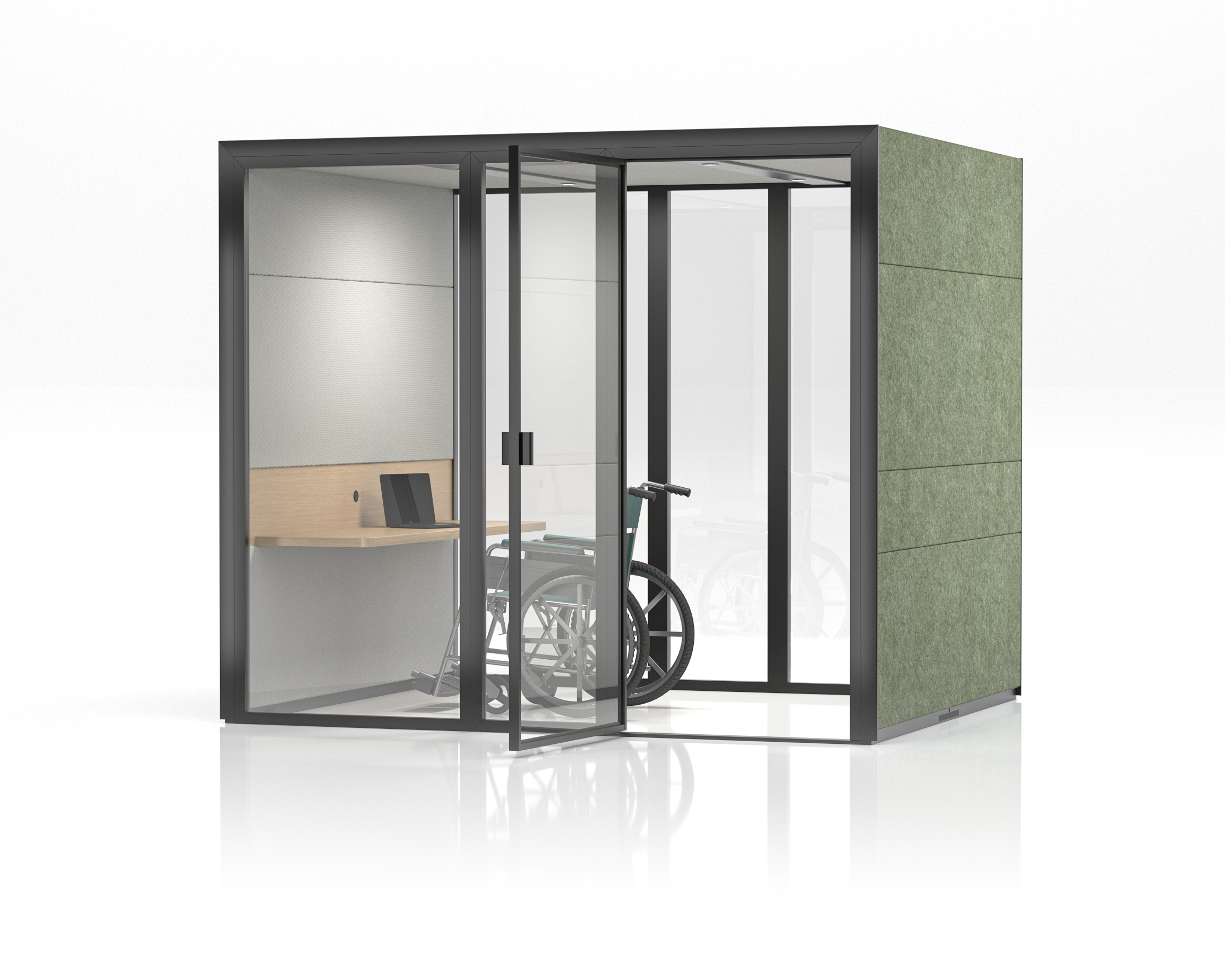
An office privacy booth should be ADA compliant by default, and a no-floor design is what makes that possible. The booth sits flush with the existing floor finish. That single design choice carries most of the accessibility argument on its own.
Every Ecolution Design pod uses a no-floor design that sits flush with any floor finish. The same no-floor choice removes a trip hazard, makes the floor easier to clean, and simplifies installation, because there is no platform to level and nothing to ramp up to. A height-adjustable tabletop is available as an option on most models, and an automatic door opener is available as an option.
Good design builds accessibility in from the start, rather than retrofitting it onto a standard unit. A booth that is only accessible as a special “accessible model” treats access as an afterthought. Building access in from the beginning is better design that works for everyone who uses the booth. For the authoritative reference on what the standards require, see the ADA Standards for Accessible Design.
What to check before you buy an office privacy booth
Before you buy, confirm six things. Check the acoustic class, the ventilation quality for a full working session, the size-to-use fit, the install and lead time, whether the unit can be reconfigured later, and what sustainability documentation is available. Work through the six in that order and the decision gets simple.
The six checks in detail
- Acoustic class. Ask for the acoustic class, not the word “soundproof.” Aim for Class A. Treat any decibel figure as a floor, not a ceiling. Genuine speech privacy needs a booth that shuts out at least 30 dB.
- Ventilation. Look for ventilation that refreshes the air comfortably through a full working session. Ecolution Design pods refresh the air inside in 2 minutes. Ask what the ventilation does, not how long the booth lets you stay inside.
- Size to use. Match the booth to the job, not to a guess about headcount. A call booth and a small meeting room are different buys.
- Install and lead time. A good booth is built on-site in less than a day and connects to a standard power outlet. Ask where the booth is manufactured, too. Ecolution Design pods are made in Grand Rapids, MI from locally sourced materials with no overseas production, which means a shorter supply chain, lower shipping carbon, and faster lead times and service.
- Reconfigurability. Ask whether you can swap the components and reconfigure the unit as the floor plan changes. Search results will call this a “portable office pod.” What you actually want is a booth that is demountable and reconfigurable, taken down and rebuilt without leaving a trace, not something you simply shove to a new corner.
- Sustainability documentation. Ask for recycled-content and recyclability figures you can put in a report.
Two red flags to walk away from
Two things belong on the do-not list while you shop: any supplier who leads with price before privacy, and any spec sheet that names a decibel figure without an acoustic class behind it.
Why Ecolution Design office privacy booths
Sound Control That Holds. Ecolution Design pods carry a Class A acoustic rating that shuts out at least 30 dB. A call inside stays inside, and the floor outside stays workable. Every pod is tested as a complete enclosure under ISO 23351-1. That two-way containment is what people actually mean when they ask for a quiet booth, and it is the first thing Ecolution Design builds every pod to deliver.
Built to Adapt and Last. Ecolution Design pods are demountable and reconfigurable across one interchangeable component grid. A change in your floor plan is a rebuild, not a demolition, and a damaged panel is a swap, not a write-off. That grid yields 56 configurations and supports true customization, with a wide range of fabric options for interior finishes that match a brand environment or an architectural brief. Each pod is made from up to 91% recycled materials, and 99% of the pod is recyclable at end of life. Everything carries a 10-year warranty.
Local US Manufacturer. Ecolution Design designs and manufactures in Grand Rapids, MI, with locally sourced materials and no overseas production. That shortens the supply chain, lowers shipping carbon, and speeds up both lead times and service. The booth reaches your floor faster, and Ecolution Design can support it after it lands.
Frequently Asked Questions
How much space does an office privacy booth need?
An office privacy booth needs only its own footprint, sized to the job, from a single-user pod to a larger Connected configuration. The no-floor design lets it sit flush against the existing floor, so it slots into a corner or an open bay without any floor prep or a raised platform to work around.
Can an office privacy booth be moved or reconfigured later?
Yes. The pods are demountable and reconfigurable, taken down and rebuilt in a new spot when the floor plan shifts, and the no-floor design leaves no trace behind. The privacy moves when the work does, instead of stranding you where you first built it.
How quiet is an office privacy booth really?
A genuine office privacy booth is rated Class A and shuts out at least 30 dB of ambient noise. In practice, someone outside can tell a conversation is happening but cannot make out the words. The person on the call is not straining to hear over the open plan.
Give your team somewhere to actually work
The floor plan will change. The need for a quiet place to take a call and think will not. An office privacy booth is the one privacy solution that does not bet against either, and that is what separates it from a wall you will eventually pay to knock down.
The real question is not whether your team needs private space. It plainly does. The question is whether you fix that space to a layout you will outgrow, or whether it moves when the work moves. Stop building rooms your floor plan will outgrow. Explore the full office pods buyer’s guide, then specify Ecolution Design booths for your next project and give privacy that moves with the work.