Sound Proof Door or Acoustic Pod: Winning Speech Privacy
A manager steps into a glass-walled meeting room to take a compensation call and closes the door. Then they lower their voice out of habit, because everyone at the desks outside can still catch the shape of what is being said. The door shut, but the privacy did not arrive. A sound proof door promises to fix exactly this, yet on its own it rarely does.
In this post, we'll take a look at:
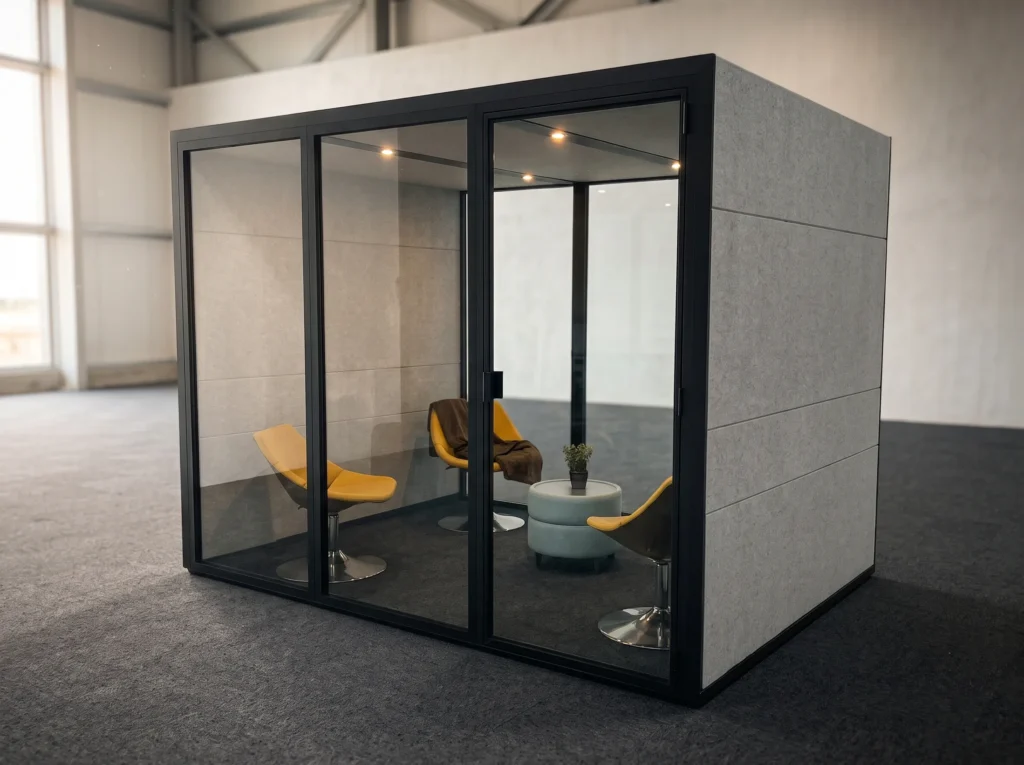
Speech privacy in a commercial interior comes from sealing a complete enclosure, not from upgrading one door slab. A modular acoustic pod from Ecolution Design delivers that sealed enclosure without construction, without a gasketed door bolted into a fixed frame, and without a retrofit. The leak is not coming through the door slab itself. Instead, it comes through every seam the builder never sealed to close: the threshold, the strike edge, the joint where a glass panel meets the frame.
A sound proof door is one perimeter-sealing detail on a room that will never move, so it is not the whole answer. The hardware catalogs that dominate this search sell the slab, not the privacy. The office is underperforming, not the worker. A modular acoustic pod belongs to a third category, neither furniture nor construction. That distinction is what makes room-level isolation possible without touching the building.
This piece covers how perimeters leak and what sound isolation ratings mean for a soundproof office. It then explains why an Ecolution Design pod seals as one assembly, sets the two approaches side by side, and maps where speech privacy matters across commercial interiors. Finally, it covers when a built sound proof door is still the right call.
How does sound leak around a sound proof door and wall perimeter?
Sound escapes through the gaps that a wall and a doorway never close. Most of the loss happens around the door rather than through it. Sealing the whole opening, not upgrading one slab, is what buys privacy. A heavy door hung in a leaky frame still hands voices to the next desk. The sound escapes through the gap at the threshold, along the strike edge, and where the frame meets the wall.
Privacy belongs to the assembled enclosure, not to any single component. Think of the opening as a system. The weakest gap sets the result no matter how good the rest of the assembly is. The honest answer to how to soundproof a door is that you cannot fix an opening by fixing one part of it.
People searching for how to soundproof a door usually reach for door acoustic insulation on the leaf first. The continuous seal around the opening is what actually decides the outcome. Sound blocking is a property of the perimeter working as one line. Noise dampening on the slab alone leaves the seams open. Open-plan floors and glass-walled rooms leak at exactly these seams. The gaps sit at every edge where two materials meet, and no single sound proof material closes a gap it does not span.
What do STC and sound-isolation ratings mean for a commercial interior?
Isolation and absorption are two different jobs. Sound isolation, measured as decibel reduction or STC, blocks sound from crossing a boundary, while absorption softens the echo inside a room. Only isolation buys speech privacy. A room stacked with soft panels can sound calm and still leak every word to the corridor, because absorption never blocks a boundary.
The goal is speech privacy, not total silence, and workplace acoustics shape wellbeing as much as they shape confidentiality. A person outside can tell a conversation is happening but cannot make out the words. That is the outcome a business buyer actually needs, a lower bar than silence and a more useful one. Ecolution Design pods carry a Class A DsA acoustic rating, and a Class A rating shuts out at least 30 dB of ambient noise. What matters for a buyer is where that number comes from. Ecolution Design measures the Class A rating on the complete assembled enclosure under the ISO standard designed for pods. Competitors, by contrast, test individual panels under ISO 354. Sound attenuation quoted on a single component describes a material, not a room.
A sound proof door rated on a bare slab tells you almost nothing on its own. What you actually hear depends on the door once it sits in its frame with its seals. The question to ask on any spec sheet is simple: does this number describe the whole enclosure, or a single slab? Acoustic insulation and sound insulation only mean speech privacy when the assembly that will actually stand in your office earned the figure. Sound blockers rated in isolation rarely survive the trip into the room.
Why a modular acoustic pod beats a sound proof door without construction
A modular acoustic pod seals as a single complete assembly. There is no gasketed door in a fixed frame to loosen or fail over time. It delivers room-level isolation without walls, without a permit, and without downtime. The enclosure holds the seal itself rather than relying on a part bolted on afterward.
You do not have to choose between acoustic performance and flexibility. That is the false choice the door catalogs quietly assume, and it does not hold. Furniture cannot give a soundproof office speech privacy or refresh the air. Construction can, but it needs walls, a permit, and weeks of downtime. An Ecolution Design pod sits in the gap between the two, and our soundproof office pods target exactly this middle ground. Every unit is built on-site in less than a day. That is what makes office soundproofing possible without a project plan. An Ecolution Design pod is demountable and reconfigurable. When the floor plan changes, the pod comes down and rebuilds elsewhere, leaving no trace on the original surface.
Sealing alone is not the whole story, and honesty about that is what separates a working enclosure from a stuffy box. A sealed space that traps heat and CO2 fails the user, no matter how good its isolation number looks on paper. That is the real problem with “just seal the door tighter” as advice. An Ecolution Design pod delivers high-quality ventilation, and the air refreshes inside the pod in 2 minutes. Ecolution Design engineers sealing and airflow together as one problem rather than trading them against each other.
Ventilation and accessibility without a threshold
The no-floor design carries the rest. The pod sits flush with the existing floor finish, with no threshold, no trip hazard, and no floor prep. That no-floor design also makes the pod compliant with ADA accessibility standards by default. Office sound deadening and room noise insulation arrive without demolition, without a threshold to trip over, and without a permit.
Modular acoustic pod vs. sealing or replacing an acoustic door: a side-by-side
A modular acoustic pod wins on speed, reversibility, ventilation, accessibility, scale, and sustainability, while a sealed or replaced acoustic door remains the economical choice for a permanent, single-purpose room. A facilities buyer is weighing two different ways to buy the same outcome. Neither option wins every row. Judge an Ecolution Design pod over the life of the space, because a demountable enclosure moves and reconfigures instead of heading to demolition. That reuse turns cost into a longer-lived asset.
| Decision axis | Modular acoustic pod | Sealing or replacing an acoustic door |
|---|---|---|
| Acoustic isolation / speech privacy | Class A, shuts out at least 30 dB, tested as a complete enclosure | Real-room result depends on the whole wall-plus-door-plus-seal assembly, not the slab alone |
| Install time and disruption | Built on-site in less than a day | Building or sealing a rated room takes weeks, a permit, and construction downtime |
| Reversibility | Demountable and reconfigurable, leaves no trace on the original surface | A built room can only be undone by demolition |
| Ventilation | Refreshes the air, with sealing and airflow engineered together | A tightly sealed door traps heat and CO2 unless HVAC already reaches the room |
| Accessibility | No-floor, flush, ADA compliant by default across the range | Doorway and room accessibility must be built in from scratch |
| Scale | Connects in series with acoustic and ventilation performance held across units | Each new private space needs another construction round |
| Sustainability / end of life | Up to 91% recycled, up to 99% recyclable, designed for disassembly | A demolished room is largely waste |
Sound reduction is only one row of this table, and a sound-insulating door can win a permanent room on its own terms. The rest of the axes are where a changing workplace pays for the difference.
Where does speech privacy matter across commercial interiors?
Speech privacy matters anywhere a confidential or focused conversation happens within earshot of people who should not hear it. In a commercial interior that means private offices, conference and huddle spaces, and healthcare intake and clinician areas. It also means education and library floors and hospitality workspaces. The need is the same in each; the stakes shift.
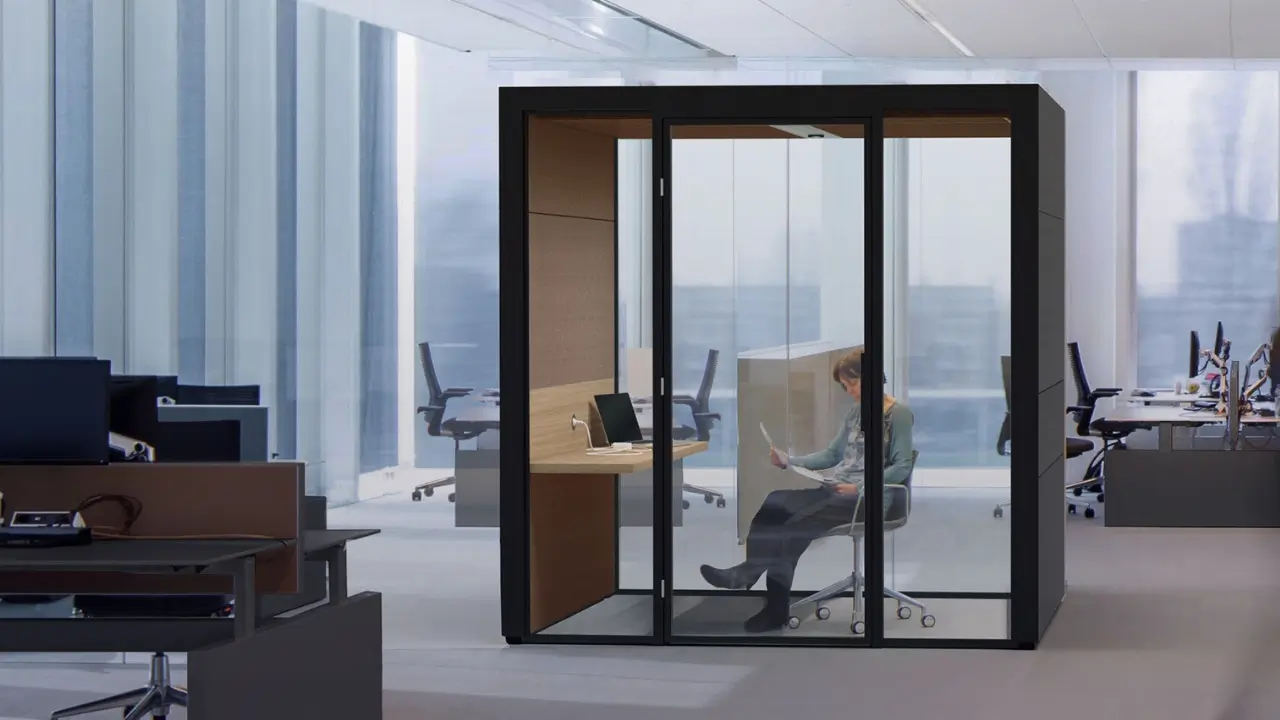
Private offices carry the calls that cannot leak: compensation, legal exposure, a candid client conversation. An executive should not have to lower their voice to keep a number private. Conference and huddle spaces have their own version of the problem now that one side of most calls is on video. A hybrid meeting that broadcasts to the open floor is both a privacy failure and a distraction. Healthcare is where a leaked sentence becomes a compliance issue. When a patient lowers their voice while the corridor still hears them, the room has failed the patient. Careful medical office interior design treats acoustic privacy as a clinical requirement, not a nicety.
Education and libraries face the sharpest collision, because open flow and private need meet on the busiest floors. A university installed Ecolution Design pods for on-demand privacy in its highest-traffic campus buildings. There, students need a quiet enclosure that appears on demand rather than a room they have to book days ahead. These are the same study pods that libraries lean on to add private space without new walls. Hospitality runs on the same on-demand logic, where a guest needs a workspace that materializes for an hour and then releases the floor.
Scaling a soundproof door alternative across a floor
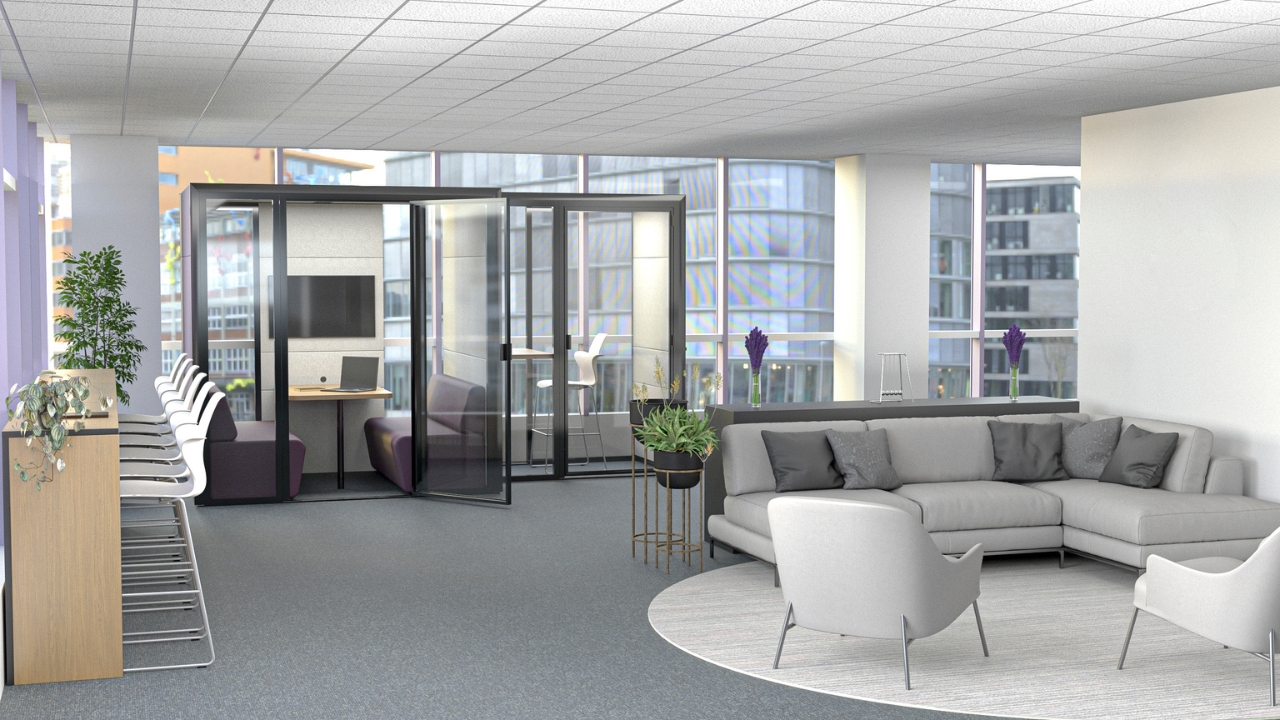
Scale is where office noise reduction usually breaks down, because most makers design their enclosures to stand alone. A recent commercial office project connected multiple Ecolution Design pods of different dimensions in series to fit an existing floor plan. The acoustic and ventilation performance held across the connected units. The whole install stayed fully reversible, with no permanent structural change. Office sound deadening that holds across a run, not just inside one box, lets a soundproof office scale without another construction round each time. That is office soundproofing treated as space rather than as a single unit.
When is sealing or replacing a sound proof door the right call?
Sealing or replacing an acoustic door is the right call when the private space is permanent and single-purpose. It also fits when the wall assembly already exists and will never move, and the room must stay exactly where it is. In those cases the door is the finishing detail, not the whole project.
A dedicated boardroom, a fixed recording or exam room built into the shell, a legally mandated permanent enclosure: these are rooms that are not going anywhere. The construction is already sunk, and the soundproof wall is already there. Door acoustic insulation then completes an assembly the builder always meant to keep permanent. Adding a rated door and a continuous seal to an existing sound dampening wall is the correct, economical move when the space is fixed.
The contrast is just as clear the other way. Choose a modular acoustic pod when the floor plan will change, when you need privacy in days rather than months, or when the space has to be reversible. An Ecolution Design pod is built on-site in less than a day, whereas building or sealing a rated room takes weeks and a permit. The decision turns on one question: will the room ever have to move?
Frequently Asked Questions
Does a sound proof door make a room private?
A door alone does not make a room private. Privacy comes from the whole opening and the enclosure sealing as one continuous line, and the door is only one detail of that. A heavy door in a leaky frame still passes voices through the threshold, the strike edge, and the joint where the frame meets the wall.
What is the difference between soundproofing and speech privacy?
Total silence is rarely the goal in a workplace, and soundproofing usually implies it. Speech privacy means a person outside can tell a conversation is happening but cannot make out the words. A Class A enclosure delivers that outcome by shutting out at least 30 dB of ambient noise. That is a more useful target than silence and the one worth specifying.